Nigeria has the terrain, the climate, and a growing global market on its doorstep. What it has lacked is a credible plan to capture any of it.
Nigeria has always grown coffee. That has never been the question. The question is why a country with the right land, the right climate, and a growing global market for speciality coffee has so little to show for it.
Part of the answer is structural. Part of it is a failure of sustained attention. And part of it is the kind of uncomfortable truth that tends to get buried under optimistic projections and policy announcements: you cannot build a processing industry for a product that people do not consume in meaningful volumes. If you are going to compete with Nestlé’s marketing, you need Nestlé’s money. That is not an excuse to do nothing. It is a call to be clear-eyed about where we are starting from.
The Collapse in Numbers
Nigerian coffee culture remains nascent. Coffee accounts for just 2.3% of non-alcoholic drinks consumed domestically. The country imports significant volumes to meet even that modest demand, from neighbouring countries, from China, and through processors in Côte d’Ivoire before it reaches Lagos shelves.
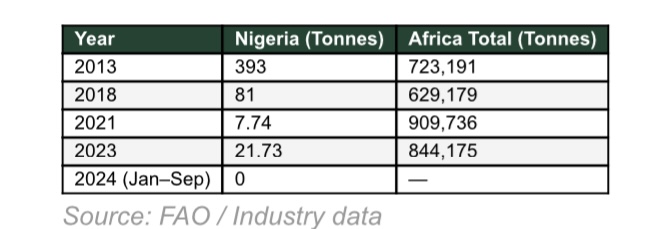
In the first nine months of 2024, Nigeria recorded zero coffee exports. Zero. While the rest of the continent was filling containers, Nigeria was not filling a single one. African exports have grown. Nigerian exports have effectively collapsed. That divergence is the business problem, and it is also the business opportunity.

The Farmers Have Been Let Down
This is the part most often glossed over in investment discussions about Nigerian agriculture.
For decades, farmers have faced inconsistent buyers, poor market prices, and almost no access to knowledge or credit. Over 90% of small-scale coffee farmers cite poor pricing and a lack of market information as the primary reason they have reduced or abandoned production.
Families in Ondo State uprooted coffee trees their grandparents planted, not because cocoa is more profitable, but because at least buyers were showing up.
Only 5.3% of farmers in key producing regions are even aware of international export quality standards. Over 64% identify poor post-harvest processing as the primary source of their losses.
Many of the country’s coffee trees are 40 to 50 years old. With labour accounting for over 95% of variable farming costs, there is almost no margin left at the farm level to invest in doing things better.
Rehabilitation must come before expansion. You cannot fix structural neglect by purchasing new seedlings.
Credit access compounds everything. Only 42.3% of coffee farmers have access to any form of credit. Back in 2019, farmers in Kogi earned an average of ₦66,291 per month from coffee with a profitability index of 0.29, a viable business, but not a scalable one without capital.
What Nigeria Actually Has
Nigeria’s highland regions, the Mambilla Plateau, Obudu, and the Jos Plateau, sit at altitudes between 1,600 and 2,000 metres with volcanic soils and annual rainfall between 2,000 and 3,000mm. These are conditions that speciality Arabica buyers spend considerable time and capital searching for globally.
The closest comparison is directly across the border. Nigeria’s highlands are geographically contiguous with the Western Highlands of Cameroon, which is now attracting serious international buyer attention. Since launching FestiCoffee in 2012, local roasting in Cameroon jumped eightfold in a single crop year. They built quality standards, farmer associations, and a national policy framework. The result is a sector that buyers are actively seeking out.
There is nothing about Cameroonian coffee that Nigerian coffee cannot match. The deficit is institutional, not agricultural.
Three Entry Points for Investors
1. The Quality-Price Arbitrage
The fastest path to revenue lies in post-harvest processing. Farmers currently dry coffee berries with the fruit coat still on, which depresses quality and leads directly to rejection at European ports. Investing in wet-processing mills and farmer training can transform the commercial grade of Nigerian beans. The price difference between poor-quality and properly processed coffee is not marginal. It is the gap between rejection and premium.
2. Infrastructure as Catalyst
It currently takes an average of 128 hours to export goods from Nigeria, against a global average of 53 hours and as little as 2 hours in the most efficient economies. The completion of the $1.5 billion Lekki deep seaport and its accompanying rail network is a structural shift.
Positioning near these new logistics hubs, in aggregation, processing, or cold-chain storage, can materially reduce the cost of reaching global buyers.
3. Institutional Tailwinds
The National Tea and Coffee Development Council Bill is moving through the Senate. The $950 million Africa Coffee Facility (ACF) has launched with a target of boosting high-quality African exports by 40%. The zero-export status of 2024 is a floor, not a permanent state.
Investors who enter now are positioned to shape market standards rather than comply with ones set by others.
The Bottom Line
What Cameroon has that Nigeria does not yet have is time, sustained attention, and deliberate investment in the people growing the crop. No magic variety. No secret infrastructure. Just consistent work, applied to the right problems, in the right order.
The potential to move from a subsistence model to a commercial one, capturing $2 billion in annual revenue through an indigenous, high-quality Nigerian value chain, is the arithmetic of what already exists on the ground, properly organised. The question is whether the private sector moves before the window closes, or waits for a policy framework that may or may not arrive on schedule.
Cobi-Jane Akinrele is the founder of Aké Collective, working with over 1,000 smallholder farmers in Nigeria’s highland states (Plateau, Bauchi, Taraba) to build traceable, EUDR-compliant supply chains for soy, coffee, and fonio. Born in the UK with Nigerian roots, she studied at Cambridge and holds a Master’s in African Studies. She writes about supply chains, compliance, and the realities of building food systems from the inside in her newsletter, Highland Lens.

Join BusinessDay whatsapp Channel, to stay up to date
Open In Whatsapp