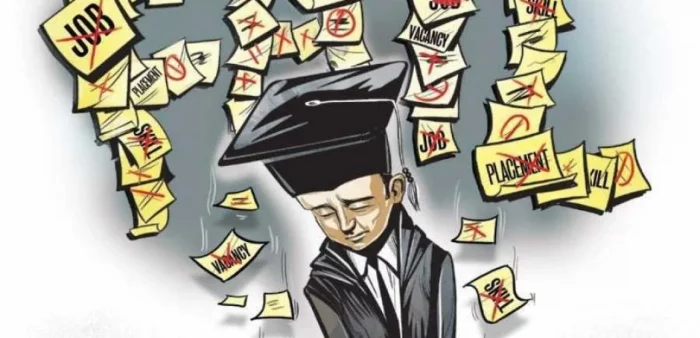
For years, a convenient narrative has dominated public discussions about unemployment in Nigeria: that universities are producing unemployable graduates. Employers complain that graduates lack practical skills, cannot communicate effectively, or are unprepared for the workplace. The conclusion often drawn is simple: Nigeria’s universities have failed.

But this explanation, while politically convenient, is dangerously incomplete. Graduate unemployment in Nigeria is not merely an educational failure. It is the visible symptom of a deeper structural crisis rooted in the nation’s weak economy, shallow industrial base, governance problems, and distorted labour market.

“The truth is that Nigeria’s economy simply does not generate enough high-quality jobs to absorb its educated workforce.”

Blaming universities alone ignores the fundamental question. Does the Nigerian economy actually have the capacity to employ the graduates it produces?

Nigeria produces hundreds of thousands of graduates every year from universities, polytechnics, and colleges of education. According to recent labour data from the National Bureau of Statistics, youth unemployment and underemployment remain among the most persistent economic challenges in the nation. Young Nigerians between the ages of 15 and 34 account for the largest share of the unemployed population, reflecting a structural imbalance between education output and economic absorption.

The truth is that Nigeria’s economy simply does not generate enough high-quality jobs to absorb its educated workforce.

One of the clearest manifestations of this structural mismatch lies in the fields Nigerian universities teach. Institutions train students in disciplines such as biotechnology, metallurgy, nuclear physics, engineering, and advanced computing. These are globally relevant skills that drive innovation and productivity in industrial economies.

But Nigeria’s economic structure offers very limited opportunities for such expertise. The nation has a weak manufacturing base, limited research infrastructure, and few high-technology industries capable of employing specialists in these fields. As a result, graduates trained for advanced industrial roles often find themselves in an economy dominated by trading, informal services, and low-productivity activities.

This mismatch produces a painful puzzle: Nigeria trains talent for industries that barely exist within its own borders.

It is therefore not surprising that many of the nation’s most talented graduates eventually leave. The ‘brain drain’ syndrome reflects this structural failure. In effect, Nigeria spends scarce resources educating skilled professionals who then contribute their expertise to other economies.

Those who remain face a different challenge, such as prolonged unemployment or underemployment. Over time, extended joblessness erodes professional confidence and weakens technical competence. This process of skill waste rarely enters public discussions about employability, yet it significantly shapes how graduates perform during job applications years after leaving school.

Another consequence of persistent unemployment is the collapse of employment choice. When jobs are scarce, graduates apply for virtually any available position, regardless of qualifications or career path. An engineering graduate may apply for banking jobs, teaching roles, sales positions, or administrative work simply to survive.

This phenomenon overwhelms employers with thousands of poorly matched applications. From the employer’s perspective, it appears as if graduates are unfocused or incompetent. In reality, it reflects a labour market suffering from severe job scarcity.

Nigeria’s employment crisis is further complicated by a problem that rarely receives sufficient attention – nepotism.

Recruitment into many public sector jobs often depends on political connections, ethnic affiliations, or personal recommendations rather than merit. The same pattern can be found in parts of the private sector, where informal networks influence hiring decisions.

When meritocracy is weakened, the labour market loses its ability to accurately measure competence. Qualified graduates may be excluded while less capable candidates secure opportunities through connections. Under such conditions, it becomes intellectually dishonest to blame universities for producing unemployable graduates.

Another frequently proposed solution is the strengthening of university-industry collaboration. In theory, such partnerships can improve practical training, internships, and research relevance. But this idea often overlooks a critical reality that Nigeria’s industrial base is extremely limited.

Compared to emerging economies such as China, India, or even South Africa, Nigeria has relatively few large-scale industries capable of hosting thousands of students for internships or collaborative research. The number of companies that truly qualify as an industry is simply too small relative to the size of the student population.

This raises an uncomfortable but necessary question of how universities can align with industries that barely exist.

Sadly, Nigeria’s largest economic sector, the informal economy, is largely ignored in policy discussions about graduate employment. Yet this sector accounts for the majority of economic activity and employment across the nation.

Instead of focusing exclusively on a small formal corporate sector, policymakers and universities should explore ways to deploy graduates as knowledge workers within the informal economy. Graduates could help improve productivity in agriculture, small-scale manufacturing, logistics, digital services, and community-based enterprises.

Nigeria’s unemployment crisis reflects deeper structural weaknesses that include limited industrial capacity, fragile economic planning, governance challenges, and labour-market distortions.

Until these systemic problems are addressed, universities will continue producing graduates for an economy that cannot fully absorb them. The solution, therefore, lies not only in reforming education but also in transforming the economy itself.

comment is free Send 800word comments to [email protected]

Join BusinessDay whatsapp Channel, to stay up to date

Open In Whatsapp