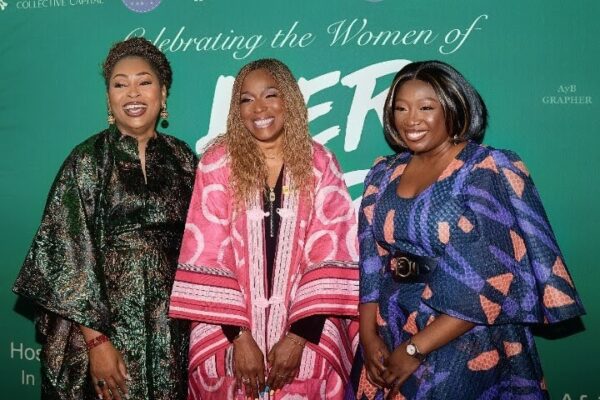
This was not a typical Women’s Month.

There were no pink logos. No ceremonial panels. No tributes that dissolved before the month was out. Instead, in the space of a few weeks, a circle of African women built something that will outlast March. Across Lagos and Johannesburg, in strategy rooms and diplomatic living rooms, on global stages and in intimate lunches, we designed the architecture of what comes next.

This is that story.

A different kind of women’s month

It began in Lagos on March 12 and 13 with the Power Woman Africa Mastermind. Twenty-five women from across the continent and the diaspora. Senior, accomplished, and building serious things. They came not to celebrate but to work.

What that room produced over two days was not just connections. It was the foundation of a continental circle that was still alive and expanding when we landed in Johannesburg weeks later. The conversations begun in the mastermind arrived in South Africa already warm. The frameworks built in Lagos found new evidence in every room we entered there.

That is the thing about rooms built with intention. They do not close when the event ends. They travel.

The stage we asked for

In Johannesburg, Radiant Collective Capital joined forces with SBB Media’s Her Story Initiative and its founder Stephanie Busari, former CNN Africa bureau chief and convener of a global leadership exchange, to bring a West African and diaspora delegation to the Forbes Summit.

It was a room that, for all its significance, had been largely shaped by a Southern African conversation. We came with Nigerian voices, West African voices, and diaspora voices. We came with a deliberate intention: to enrich a room that needed the full breadth of the continent to tell its own story accurately.

We asked for the stage. Not because we were invited. Because we belonged there.

When we stepped forward to share our voices and our vision for Africa, something shifted in the room. Not dramatically. But perceptibly. The stories of women shaping industries and communities across this continent are not a regional story. They are a continental one. And a continental story requires continental voices.

The evening before the Forbes Summit, we were invited to SABC. We were heard. We shared our stories. And what struck me, sitting in that studio, was something deceptively simple: sharing our stories connects us. Not just emotionally. Strategically. Because a woman who does not know your story cannot become your partner, your investor, your ally, or your market.

A story is not soft power; a story is infrastructure.

The Consul General’s table

The evening that followed was unlike any diplomatic gathering I have attended.

The Consul General of Nigeria to South Africa, Ambassador Ninikanwa Okey-Uche Mni, opened her home to 40 women. South Africa meets Nigeria, plus voices from across the African diaspora. She did not receive us as a diplomat receiving guests would. She welcomed us as a woman with family and sisters, welcoming women doing the work of building a continent.

That reframing changed everything.

What Radiant Collective Capital, SBB Media, and Stephanie Busari co-created with the Consul General that evening was not an event. It was a strategic third space: personal enough for honesty, consequential enough to matter. South African women spoke about doing business in Nigeria. Representatives from Brand SA and Invest SA engaged on investment and partnership. I shared the vision of Radiant Collective Capital and the power of women funding the future of Africa. The AfCFTA was not discussed as a trade framework that evening. It was discussed as a sisterhood strategy.

Because here is what the official AfCFTA conversation sometimes misses: the fastest route to continental economic integration is not always through formal institutional channels. It is through the trust networks that women build when they are in a room together without an agenda beyond honest exchange. When the myth of Nigeria and South Africa as rivals is replaced by the reality of forty women discovering how much they have to offer each other, the continent moves.

That is not a diplomatic achievement. That is architecture.

The Watershed

After the Consul General’s dinner, the circle expanded again.

In Johannesburg, fifteen women gathered in a room that became something none of us had fully planned for. A Botswana businesswoman and a corporate South African sat across from each other and discovered they were building toward the same thing from different sides of the continent. The Lagos twenty-five and the Johannesburg fifteen are now one continental circle. That is what intentional building looks like when it compounds across borders.

There was lunch at Butchers in Mandela Square, Sandton, one of my favourite places in that city, where the West African delegation sat together in conversation that moved between the personal and the profound. The kind of lunch that does not end when the bill arrives.

And there was Khanyi. The young woman who project-managed the Johannesburg events with a precision and grace that caught my attention immediately. The opportunity to bring her into work with me, a Nigerian woman investing in a young South African woman’s growth, felt like the whole trip distilled into one relationship. The richness of that exchange, for her and for me, is what this work gives that no title or platform can replicate.

I am the holder of this circle. And in holding it I am held by it. Every room I convene expands me as much as it expands the women inside it. That is not incidental to the work. That is the work.

Owning the narrative

When we walked into Forbes as a delegation and asked for the stage, we were not being presumptuous. We were being accurate. African women are shaping industries, funding futures, crossing borders, and building the infrastructure of the next economy. The stage was always ours. We simply had to say so.

Owning our narrative is not a communications strategy. It is an economic one. The story of African women in leadership, told by African women, on global platforms, in diplomatic spaces, in masterminds and third spaces across the continent, is the story that will attract investment, partnership, policy attention, and the next generation of women who need to see what is possible.

We are not waiting to be discovered. We are building the infrastructure of our own visibility.

What comes next

The rooms we built across these weeks were not separate events. It was a single statement made in multiple languages, across multiple borders, to multiple audiences.

African women are not a regional story. We are not a niche market. We are not a development conversation. We are a continental force building cross-border capital networks, sharing stories that change the shape of rooms, opening diplomatic tables as sisters rather than supplicants, and convening the strategy rooms where the next chapter of African economic life is being designed.

The room we built is not finished. It never will be. Every woman who asks for the stage, opens her home, shares her story, or pulls up a chair for someone who needs it is adding to the architecture.

That is the work. And it has never been more visible, more urgent, or more alive.

For now: find the room. Build it if it does not exist. Ask for the stage when you arrive.

The women. Wealth. Power. The column appears weekly in BusinessDay. The Blueprint by Udo Okonjo carries the work behind the work.

Udo Okonjo is CEO of Fine & Country West Africa and founder of Radiant Collective Capital. She has been building infrastructure for women in leadership and wealth since 2010.

Udo Maryanne Okonjo is a board director, wealth strategist, and investor. As Executive Chair of Fine &Country West Africa and Founder of Radiant Collective Capital, she champions women-led wealth, Impact and Legacy across Africa and Beyond.

Join BusinessDay whatsapp Channel, to stay up to date

Open In Whatsapp