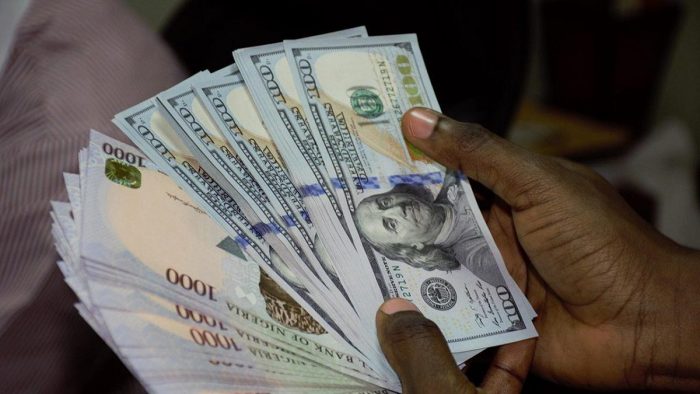
The naira strengthened in the official foreign exchange (FX) market on Tuesday, buoyed by improved liquidity conditions even as Nigeria’s external reserves extended their recent decline, highlighting the delicate balance facing policymakers.

Data from the Central Bank of Nigeria (CBN) showed the local currency appreciated by N5.75, with the dollar quoted at N1,382.63, representing a 0.42 percent gain compared to N1,388.38 recorded on Monday at the Nigerian Foreign Exchange Market (NFEM).

In the parallel market, commonly referred to as the black market, the naira held firm at N1,415 per dollar, reflecting relative stability in that segment of the market. However, the spread between the official and parallel market rates widened to N33 on Tuesday from N27 recorded a day earlier, indicating lingering distortions in pricing across segments.

Read also: Nigeria FX inflows jump to $4.4bn as Naira slides on renewed demand

Nigeria’s foreign-exchange inflows rose for a third consecutive month in February, driven by strong offshore investor participation, even as the naira came under renewed pressure amid rising demand and declining external reserves.

Data from FMDQ showed total FX inflows into the market climbed 45 percent month on month to $4.4 billion, underscoring improving liquidity conditions. The increase was largely fueled by foreign portfolio investors seeking to take advantage of Nigeria’s high-yield environment, reinforcing the country’s appeal as a carry trade destination.

Nigeria’s external reserves, which provide the Central Bank with the capacity to support the currency and meet external obligations, have continued to trend downward. The reserves declined for the sixth consecutive session, falling by 0.84 percent to $49.60 billion as of March 23, 2026, from a recent peak of $50.02 billion recorded on March 11, 2026.

Despite the short-term dip in headline reserves, a report by VNL Capital Asset Management points to a significant improvement in the underlying quality and usability of Nigeria’s external buffers, suggesting a more resilient position than the topline figures may indicate.

According to the report, net usable reserves, defined as the portion of reserves readily available for immediate deployment, have risen sharply over the past two years. These increased from $3.99 billion at the end of 2023 to $23.11 billion by December 2024, and further to $34.80 billion by the end of 2025, reflecting a marked enhancement in liquidity.

Gross reserves have also strengthened, now exceeding $45 billion and providing import cover of close to 10 months, well above conventional adequacy thresholds. This indicates a stronger capacity to withstand external shocks and meet import demands without undue pressure on the currency.

The improvement in reserve quality has been driven by a combination of structural reforms implemented by monetary authorities. These include the unification of the foreign exchange market, the clearance of legacy swap obligations and previously undisclosed liabilities, and the removal of fuel subsidies, all of which have eased pressure on Nigeria’s external accounts.

At the same time, improved policy credibility has supported increased inflows from remittances, non-oil exports, and foreign investment. Tight monetary conditions have also played a role in stabilising the external sector by curbing excess demand for foreign exchange.

In addition, the Central Bank’s strategy of accumulating gold has further strengthened the composition of reserves. Gold holdings rose to approximately $2.6 billion by late 2025 and increased further to $3.5 billion in the first quarter of 2026. Notably, these purchases were funded in naira using domestic mining output, thereby preserving foreign exchange while enhancing diversification.

Read also: Naira posts N34.48 single-day loss as external reserves decline further 

This approach provides a natural hedge against inflation and exchange rate volatility, while improving the overall resilience of the reserve portfolio.

Overall, analysts say Nigeria’s external reserve position is now stronger, more transparent, and less encumbered than in previous years. Liquidity risks have declined significantly, and the Central Bank has gained greater flexibility in managing the exchange rate and responding to external shocks.

Crucially, these gains have been achieved with limited reliance on additional external borrowing, underscoring a shift toward more sustainable reserve management even as short-term pressures persist.

Hope Moses-Ashike is an Associate Editor, Banking and Finance, with more than a decade of experience reporting on Nigeria’s financial system and broader economy. She closely tracks market movements, monetary policy decisions, company disclosures, regulatory actions, economic indicators, and global developments, and interprets what they mean for businesses, investors, policymakers, and households. Her reporting helps readers understand complex issues such as inflation trends, foreign exchange market dynamics, interest rate decisions, bank performance, and investment risks. She also covers major international events and periodically travels to Washington, D.C., to report on the World Bank/IMF Spring and Annual Meetings. Her dedication to financial journalism has earned her multiple recognitions and invitations to high-level professional development programmes. She is an alumna of the International Visitors Leadership Programme (IVLP) in the United States and holds an Advanced Financial Journalism Certificate from the Press Association Training in London, UK. Her other notable achievements include completing the Lagos Business School CMC Programme, the Bloomberg Media Africa Initiative Programme, and a Master Class in Journalism at Rhodes University in South Africa.

Join BusinessDay whatsapp Channel, to stay up to date

Open In Whatsapp