…As Ogbuku calls for return of fleeing investments to oil region
Partnership between the Niger Delta Development Commission (NDDC) and the Ibom Air of Akwa Ibom State may lead to emergence of a regional aviation power in the Niger Delta. It could help to boost the aircraft fleet in Ibom Air and maybe other emerging airlines in the oil region and help air patronage in travel and hire services, thus creating a strong hub in aviation in the region like in Lagos.
This as Samuel Ogbuku, managing director of the NDDC, has urged fleeing businesses and investments to head back to the oil region. He has also called on indigenes of the region to think of investing in the region first, regretting that the trend on ground is investing outside the region.
On collaboration, the NDDC re-emphasised the importance of strategic collaborations through the Public-Private Partnerships (PPP) arrangement to drive sustainable development in the Niger Delta region.
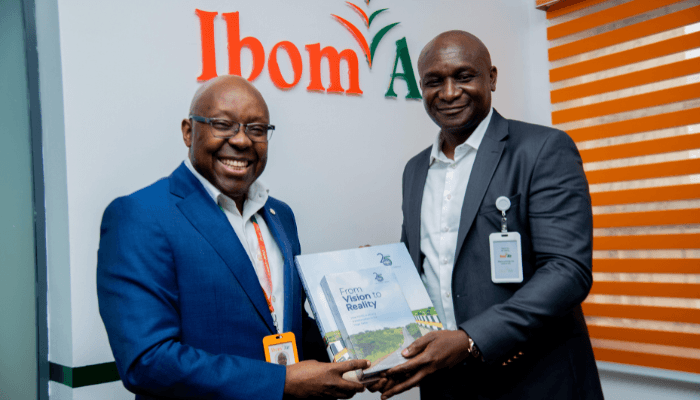
Ogbuku stated this during a meeting with the management of Ibom Air led by George Uriesi, the Chief Executive Officer, at their headquarters in Uyo, Akwa Ibom State.
Ogbuku led a delegation that included Victor Antai, the Executive Director (Projects), Ifedayo Abegunde, Executive Director (Corporate Services), Abasiandikan Nkono, the Akwa Ibom State Representative on the NDDC board, and other directors of the Commission.
The NDDC boss observed that the engagement was part of the Commission’s ongoing commitment to strengthening PPPs that pave the way for landmark infrastructure projects and boost investor confidence.
He stressed that collaboration would expedite the growth and development of the Niger Delta region, noting that the NDDC was partnering with the Delta State Government and Chevron Nigeria Limited on the 70.75 km Omadino-Okerenkoko-Escravos Road and bridges in the Warri North Local Government Area of Delta State.
Ogbuku recalled that the partnership between the Shell Petroleum Development Company of Nigeria Limited and the NDDC facilitated the construction of the 25.7 km Ogbia-Nembe Road. He added that the Commission was currently collaborating with the Nigeria Liquefied Natural Gas (NLNG) on the construction of the Okrika-Borikiri Road and bridges project, the Kaa-Ataba Road and Bridge, and the Bonny Ring Road.
The NDDC MD stressed the importance of aligning efforts between the government, NDDC, and the private sector through collaborative planning to effectively transform transit traffic into sustainable economic growth for the Niger Delta region.
He remarked that through strategic partnerships, the NDDC would create a thriving economic environment that benefits the local communities and attracts further investment in the region.
“As we prioritise local content by engaging indigenous contractors and promoting diversified investments, we can significantly enhance the economic impact in our area,” he said.
Speaking earlier, Uriesi of Ibom Air described the partnerships as one of the airline’s strategies for development through impactful initiatives.
He underscored the benefits of establishing a regional aviation hub that could not only enhance transportation but also stimulate tourism and business activities in the Niger Delta region.
…..bring back investments – NDDC boss
On investments, the NDDC MD called on stakeholders and the private sector to attract investments back to the Niger Delta region, stressing that sustainable development can only be achieved through collective commitment and strategic partnerships.
Speaking at the Niger Delta Business Roundtable organised by the Niger Delta Chamber of Commerce, Industry, Trade, Mines and Agriculture (NDCCITMA) in Port Harcourt, Ogbuku stated that the current leadership of the Commission was determined to change the narrative by transitioning from transactional engagements to transformational development.
He said: “When we assumed office, there were numerous unfinished projects, but we have taken deliberate steps to complete them. We are encouraged by the assurance of Mr President of a stable four-year tenure, which places a moral responsibility on us to deliver results.”
The NDDC boss emphasised that the region must unite to address its shared challenges, particularly insecurity, which has driven urban migration and slowed economic growth.
He noted that addressing power supply challenges and curbing criminality informed the Commission’s ‘Operation Light Up the Niger Delta’ initiative.
Highlighting ongoing and completed projects, Ogbuku listed key interventions such as the Okitipupa electrification project in Ondo State; the Ogbia–Nembe Road and Bridge; the Okrika road and bridge project; the Kaa–Ataba Road and Bridge; the Bonny Ring Road and the Regional Hospitals in Rivers and Cross River states.
He also disclosed ongoing collaboration with the Delta State Government on the 70.75-kilometre Omadino–Okerenkoko–Escravos Road and Bridges project.
The Managing Director further noted that the Commission had intensified its human capital development programmes, including training 500 youths in Compressed Natural Gas (CNG) conversion and creating a database to match beneficiaries with future opportunities based on competence.
Ogbuku acknowledged that past challenges, including frequent leadership changes, contributed to abandoned projects and to the erosion of public confidence in the Commission. He, however, assured stakeholders that stability under the current administration would restore trust and improve performance.
He disclosed that the establishment of the Niger Delta Chamber of Commerce, Industry, Trade, Mines and Agriculture was intended to insulate the Commission from political pressures while supporting businesses in the region.
Calling on the private sector to take a leading role, he said: “The government provides infrastructure, but it is the private sector that drives business growth. The Niger Delta is peaceful and offers a viable platform for investments.”
In his remarks, Boma Iyaye, the NDDC Executive Director (Finance & Administration), commended the NDCCITMA for organising the Niger Delta Business Roundtable and appreciated the efforts of beneficiaries who had repaid their loans.
Earlier, Idaere Gogo Ogan, the Chairman of the NDCCITMA board, revealed that about 13,000 applicants had applied for loans, with over 3,000 businesses benefiting from the scheme, many of whom have begun repaying. He urged participants to harness the region’s vast economic opportunities and contribute innovative ideas for prosperity.
In his remarks, Solomon Edebiri, the board secretary, traced the evolution of the Chamber, noting that it had begun making significant impacts within a short period. He highlighted the region’s strengths in agriculture and the blue economy, stressing the need to diversify beyond oil and gas.
Edebiri pointed out the disparity in export capacity between Lagos and Port Harcourt, noting that while Lagos accounts for about $200 million in exports, Port Harcourt records significantly lower figures. He said the roundtable was designed to unlock business opportunities and address economic challenges in the region.
Delivering the keynote address, Simbi Kesiye Wabote emphasised the need for a new development agenda driven by strategic planning and regional collaboration. He observed that although the Niger Delta contributes about 80 per cent of Nigeria’s earnings, the level of infrastructure and per capita income does not reflect this contribution.
Wabote called for the implementation of a Regional Master Plan, stressing that past development efforts were largely influenced by politics rather than sustainability. He urged stakeholders to build strong business institutions, set measurable targets, and foster synergy among the Niger Delta states to achieve long-term economic growth.

Join BusinessDay whatsapp Channel, to stay up to date
Open In Whatsapp