


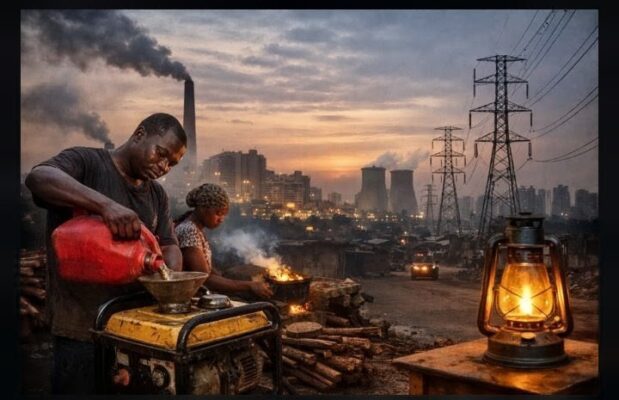
Nigeria’s climate crisis is often framed as an emissions problem. In reality, it is a power shortage. The country’s low carbon footprint reflects not environmental efficiency, but a structural lack of reliable electricity, one that forces households and businesses into costly and carbon-intensive alternatives.
Despite accounting for roughly 0.3 percent of global carbon emissions according to the World Bank data from 2022. Yet the country is increasingly drawn into a global climate framework designed for high emitters, even as it struggles with a more immediate structural constraint: insufficient access to energy.
This misalignment sits at the centre of Nigeria’s climate challenge. The issue is not excess carbon; it is too little power.
An energy deficit, not an emissions surplus
Across much of the country, electricity supply remains inconsistent. Grid output averages 4,000 to 5,000 megawatts for a population exceeding 200 million. By comparison, South Africa generates close to 40,000 megawatts for fewer than 60 million people according to the International Energy Agency in 2023. The gap is structural.
According to the World Bank, tens of millions of Nigerians lack access to electricity, while many more experience unreliable supply. In response, households and businesses turn to alternatives that are both expensive and carbon-intensive. Petrol and diesel generators have become a parallel energy system, and in rural areas, biomass including firewood and charcoal remains the dominant household energy source according to a report from the International Energy Agency in 2023.
Nigeria’s emissions profile reflects this imbalance. Per capita carbon emissions remain below one tonne annually, far lower than levels in advanced economies such as the United States or industrial emitters like China. From a global perspective, Nigeria is not a major contributor to climate change. Domestically, however, the absence of reliable energy drives environmentally inefficient behaviour.
When energy poverty drives emissions
Energy poverty and climate outcomes are closely linked. When clean, grid-based electricity is unavailable, households substitute biomass. When firms cannot rely on public supply, they invest in diesel generation. The result is a pattern of emissions that is inefficient and difficult to regulate.
As Fatih Birol, executive director of the International Energy Agency, observes, “Energy access and climate action must go hand in hand. Without reliable electricity, progress on emissions reduction will be limited.”
The economic cost is substantial. Energy accounts for a significant share of operating expenses for Nigerian businesses, in some cases up to 40 percent. This raises production costs, feeds into inflation, and reduces competitiveness. Estimates suggest unreliable power supply imposes losses exceeding 25 billion dollars annually according to the World Bank in 2022.
The policy contradiction
Global climate strategies emphasise rapid decarbonisation, often prioritising renewable energy deployment. In Nigeria, however, the challenge is not simply to replace existing energy sources but to expand supply in the first place.
Intermittent energy sources such as solar and wind face integration limits in a grid that is already fragile. Without stable baseload capacity and improved transmission infrastructure, scaling renewables alone cannot meet demand.
At the same time, Africa receives less than five per cent of global climate finance flows, despite high vulnerability to climate shocks, according to a report by UNEP in 2023. This creates a gap between ambition and implementation.
As Akinwumi Adesina, former president of the African Development Bank, has argued, “Africa cannot industrialise in the dark. Energy access is fundamental to economic transformation and climate resilience.”
Efforts to align with global climate targets risk overlooking domestic realities. A transition that does not first address supply constraints may slow industrialisation, increase energy costs, and deepen inequality.
Sequencing the transition
A grounded approach would expand reliable energy access while gradually improving the carbon intensity of supply. Nigeria’s abundant natural gas can serve as a transition fuel. Distributed energy systems can extend electricity to underserved communities, and grid infrastructure upgrades can increase efficiency and reduce losses. Over time, renewable energy can scale within a more stable system.
This is not a rejection of climate goals; it is a question of sequencing.
Kelvin Oigiangbe, a software engineer at BuildingMinds GmbH working on energy systems in Nigeria, notes, “Reliable energy access is the foundation on which climate solutions become viable. Without it, households and firms fall back on options that are both costly and environmentally damaging.”
Additional perspectives underscore the urgency. Professor Chukwumerije Okereke, a climate and energy expert in Nigeria, has observed, “Lack of access to modern energy is one of the greatest challenges and causes of poverty in the country. Expanding energy access is a prerequisite for any meaningful climate action.”
Similarly, a climate analyst says, “Climate finance effectiveness depends on operational realities. Without infrastructure to deploy clean energy, funding does not translate into impact.”
A climate debate grounded in reality
The distinction matters. Climate policy designed for energy-abundant economies cannot be applied unadjusted in energy-constrained ones.
Nigeria does not face a classic emissions problem. It faces a development constraint with climate implications. Addressing that constraint requires policies that recognise the relationship between energy access, economic growth, and environmental outcomes.
Nigeria’s climate challenge is not too much carbon; it is too little power.

Join BusinessDay whatsapp Channel, to stay up to date
Open In Whatsapp


