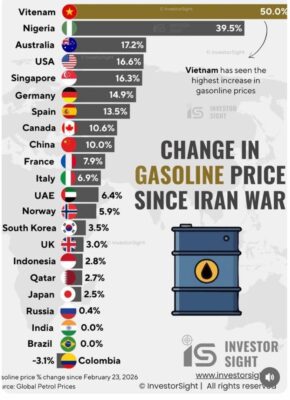
…Only African country in top 20

Nigeria has recorded one of the sharpest increases in petrol prices globally following the geopolitical shock linked to the Iran war, highlighting the country’s persistent vulnerability to external oil market disruptions despite being a major crude producer.

Data from InvestorSight, citing Global Petrol Prices, showed that petrol prices in Nigeria have surged by 39.5 percent since February 23, 2026, placing the country second only to Vietnam, where prices spiked by 50 percent over the same period.

The development highlighted the paradox at the heart of Nigeria’s energy economy, Africa’s largest oil producer remains highly exposed to fluctuations in international refined product markets due to structural deficiencies in domestic refining capacity and pricing mechanisms.

Global shock, local pain

The Iran war has triggered volatility across global energy markets, tightening supply expectations and driving up crude benchmarks. While oil-producing countries might typically benefit from higher crude prices, Nigeria’s downstream sector tells a different story.

Unlike countries with robust refining systems, Nigeria still relies significantly on imported petroleum products. This leaves domestic pump prices highly sensitive to international price movements, exchange rate pressures, and logistics costs.

Read also: Nigeria records world’s sharpest petrol price rise amid Middle East war

The nearly 40 percent increase in petrol prices reflected this exposure, amplifying inflationary pressures in an already fragile economy where energy costs directly influence transportation, food prices, and overall cost of living.

Comparative global context

Nigeria is the only African country to record such a surge in the prices of petrol since the Middle East conflict started. The country’s petrol price surge far outpaces that of several advanced economies.

For instance, increases in countries such as the US (16.6 percent), Germany (14.9 percent), and Canada (10.6 percent) remain lower.

Even major Asian importers like Japan (2.5 percent) and South Korea (3.5 percent) have seen relatively modest adjustments.

Further analysis revealed that among oil-exporting nations, the disparity is even more striking. Countries such as Qatar (2.7 percent) and the United Arab Emirates (6.4 percent) recorded far smaller increases, reflecting stronger domestic refining capacity and state-backed price stabilisation frameworks.

In contrast, Nigeria’s sharp rise signals limited insulation from global shocks.

Structural fault lines

Energy analysts attributed Nigeria’s vulnerability to three core issues: inadequate refining infrastructure, foreign exchange constraints, and the establishment of a strategic petroleum reserve (SPR).

Timothy Okon, Managing Partner at Teno Energy, in an interview with a local TV station, said Nigeria must urgently implement SPRs to protect the country from global supply disruptions and stabilise fuel availability nationwide.

“The crisis we now find in our hands is not instigated by Nigeria, and therefore the consequences necessarily come from what economists would call negative externalities.”

He said that disruptions in global supply routes, particularly the Straits of Hormuz, have constrained global crude supply, affecting market stability and pricing.

Although efforts to boost local refining, including the ramp-up of private sector investments, are ongoing, competition gaps persist. This has forced marketers to clamour for import licensing, exposing the market to global price swings.

In addition, the depreciation of the naira has compounded the impact, making imported fuel expensive in local currency terms. The removal of fuel subsidies, while aimed at easing fiscal pressure, has also transferred the full burden of price volatility to consumers.

Sharing the same sentiment, Kelvin Emmanuel, Managing Partner, Energy Consulting Practice, asserted that Nigeria lacks SPRs and shipping capacity required to benefit from global energy disruptions triggered by the escalating Middle East conflict.

“Nigeria does not have a strategic petroleum reserve stock for times like this conflict that is separate from the crude held at terminals. Nigeria does not have any crude oil stored for a rainy day.”

Economic ripple effects

The consequences of rising petrol prices are far-reaching. Transport fares have climbed sharply across major cities, while businesses reliant on fuel-powered logistics and generators face escalating operating costs.

For households, the surge translated into reduced disposable income and heightened economic strain, particularly for low- and middle-income earners.

Inflationary pressures are expected to intensify in the coming months, with energy costs feeding into broader price levels across sectors.

“If it’s (refined petroleum products) not available, it’s going to have a huge impact and higher prices mean more inflation, which means higher interest rates,” said James Gooder, Vice-President (Crude Oil), Argus Media.

Policy implications

The latest data reinforces the urgency of accelerating reforms in Nigeria’s downstream petroleum sector.

Analysts argued that expanding domestic refining capacity, stabilising the foreign exchange market, and improving supply chain efficiency are critical to mitigating future shocks.

More from our Energy Column

Join BusinessDay whatsapp Channel, to stay up to date

Open In Whatsapp