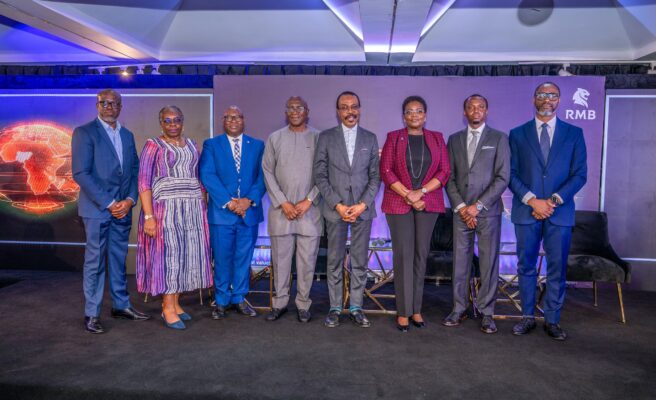
RMB Nigeria Limited said sustained policy reforms and the expansion of sustainable finance will determine whether Africa’s most populous economy can convert recent macroeconomic adjustments into durable growth, as investors weigh Nigeria’s reform momentum against global volatility.
At its 2026 Economic Forum in Lagos, the investment bank brought together policymakers, executives and financiers to examine Nigeria’s outlook, arguing that institutional strengthening and scalable transition-finance structures are central to rebuilding confidence and deepening capital markets.
Bayo Ajayi, chief executive officer of RMB Nigeria said the West African nation is at an “inflection point,” with ongoing reforms offering a chance to accelerate growth and restore investor trust if policy consistency is maintained.
Read also: RMB closes $285m Axxela deal as Nigeria pivots to gas
“This is a defining moment,” Ajayi told participants, pointing to exchange-rate adjustments and fiscal measures that authorities say are designed to stabilise the economy after years of distortions.
The keynote speaker, Bismarck Rewane, chief executive of Financial Derivatives Company Limited, said Nigeria’s reform agenda must be anchored on fiscal discipline, monetary stability and structural transformation to withstand external shocks.
“Strong institutions and predictable policy frameworks are essential to attracting long-term capital,” Rewane said, adding that industrialisation and export competitiveness would be critical to sustaining growth amid global uncertainty.
Nigeria has embarked on sweeping reforms over the past two years, including exchange-rate liberalisation and fuel-subsidy removal, moves that initially stoked inflation but were aimed at narrowing fiscal gaps and improving foreign-exchange liquidity.
Read also: RMB ranks second-best employer in Nigeria for 2026
Investors are now assessing whether those steps will translate into stronger capital inflows and broader economic resilience.
A second panel at the forum focused on sustainability and transition finance, reflecting a shift in how lenders and corporates are approaching energy and infrastructure funding.
Tshepo Ntsane, a sustainable-finance transactor at RMB, said Africa’s energy transition must balance climate goals with energy access and security.
For Nigeria, where power shortages and infrastructure gaps constrain output, transition finance must be pragmatic and tailored to local realities, he said.
“Economic diversification and industrial competitiveness depend on well-structured sustainability strategies,” Ntsane said, noting that capital providers are increasingly scrutinising governance standards and environmental metrics before committing funds.
Panelists including executives from Dangote Industries Limited, Bank of Industry and InfraCredit said credible sustainability frameworks are becoming a prerequisite for accessing both domestic and international debt markets.
Read also: RMB acts as lead issuing house for Presco’s N236 billion capital raise
Laju Atake, head of debt capital markets at RMB Nigeria, said issuers seeking sustainable funding must articulate clear transition plans and identify eligible projects aligned with recognised standards.
Financial institutions play a structuring role by linking those projects to pools of capital targeting environmental and social outcomes, Atake said.
The discussions come as global investors tighten scrutiny of emerging markets, demanding clearer reform trajectories and measurable climate commitments before allocating funds.
For Nigeria, that means sustaining policy coherence while scaling instruments such as green bonds and transition-linked facilities.
RMB Nigeria, part of South Africa-based FirstRand Group, said it sees growing appetite for sustainable instruments tied to infrastructure, energy and industrial development, provided reforms continue and regulatory clarity improves.
Participants broadly agreed that Nigeria’s long-term growth prospects hinge on maintaining reform momentum and strengthening institutions capable of supporting private investment.

Join BusinessDay whatsapp Channel, to stay up to date
Open In Whatsapp