

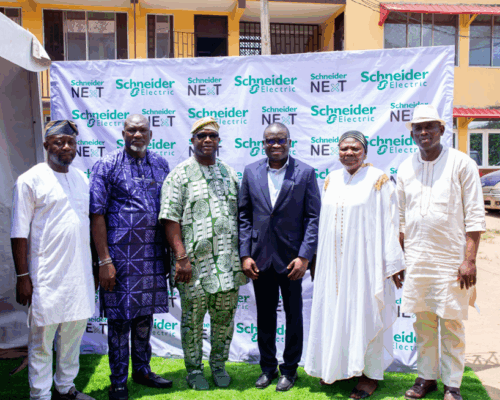
Schneider Electric has commissioned a solar power installation at a Lagos public school, marking the French energy management company’s first community initiative of 2026 in Nigeria as it seeks to address the intersection of energy poverty and educational inequality across the country.
The system, installed at Ikeja Central Grammar School in Lagos, serves a community of more than 500 students and teachers who had gone without reliable electricity for two years. The project is part of the company’s global Access to Energy program, which targets underserved communities across education and healthcare sectors.
The technical setup includes 3.3 kilowatts-peak of photovoltaic capacity, a 4-kilowatt hybrid inverter, and a 10-kilowatt battery storage system capable of generating roughly 12 kilowatt-hours of electricity daily. The installation is monitored remotely through Schneider’s EcoStruxure Energy Access platform, which manages power distribution in line with the school’s operating schedule.
The installation targets a structural gap in Nigeria’s public education infrastructure. More than half of the country’s primary and junior secondary schools operate without reliable power, according to estimates cited by the company, a deficit that hampers access to digital learning tools, limits classroom comfort, and constrains teachers’ ability to deliver effective lessons.
For Ikeja Central Grammar School, the consequences had been concrete. Before the installation, the school lacked the power necessary to run fans, internet connectivity, water systems, or basic administrative equipment. Sanni Kudirat, head teacher described the shift as immediate.
“The children are extremely excited because light has finally come,” she said at the commissioning. “Students are happier to come to a conducive learning environment. We can already see improvements in their concentration and participation.”
Schneider Electric’s move reflects a broader trend among multinational energy and industrial companies to align corporate social responsibility spending with measurable sustainability benchmarks. The project is structured around two United Nations Sustainable Development Goals, SDG 4 on quality education and SDG 7 on affordable and clean energy , frameworks increasingly used by corporations to anchor ESG commitments to defined metrics.
Ajibola Akindele, country president for Schneider Electric’s Anglophone Africa operations, signaled the company intends to scale the effort. “Our expectation is to expand initiatives like this across Nigeria, reaching more children and helping to build a brighter future for the next generation,” he said at the commissioning event.
The project was implemented with approval from the Lagos State Universal Basic Education Board, a detail that could ease the path for replication across other state schools if government buy-in at the local level holds. Moyosore Adebanjo, executive chairman of Onigbongbo Local Council Development Authority, where the school is located, publicly backed expansion. “We look forward to further exploring and building partnership opportunities with Schneider Electric to benefit more students across the state,” he said.
The economics of small-scale solar deployments have improved markedly over the past decade, and the Ikeja installation, modest in size but operationally self-sufficient, illustrates how off-grid or hybrid solar systems can deliver meaningful impact without large capital outlays. The remote monitoring capability, in particular, reduces the need for on-site maintenance personnel, a practical consideration for scaling across geographically dispersed school networks.
Whether Schneider can replicate the model at a meaningful scale will depend on sustained funding commitments and continued regulatory cooperation from state education authorities. Nigeria’s public school network numbers in the tens of thousands, a scale that would require either significant corporate investment or co-financing arrangements with government or development finance institutions.
For now, the Ikeja installation stands as a proof of concept: that targeted energy infrastructure investment can produce swift, visible improvements in learning conditions, and that the appetite among local authorities to partner on such initiatives exists.


Join BusinessDay whatsapp Channel, to stay up to date
Open In Whatsapp


