NIGERIA ENERGY SECURITY SERIES · (PART 1 OF 2)
In 2013, Nigeria completed the most ambitious energy sector privatisation in Sub-Saharan Africa. Generation and distribution companies were handed over to private investors. Regulatory architecture was put in place. The promise of reliable power, commercial discipline, and private investment was the same playbook that had just transformed Nigerian telecoms from near-zero to over 100 million subscribers in a decade.
Thirteen years later, the lights are still not reliably on.
This article diagnoses why. Not as a verdict on privatisation as a concept, but as a precise account of where the model broke down and which specific constraint, left unaddressed, will continue to limit every naira invested in the sector.
The answer is the grid. And the evidence is in the numbers.
How the Nigerian power sector is structured
The Nigerian Electricity Supply Industry (NESI) is formally unbundled into three main segments, with two important intermediaries:
Generation (GenCos) – 30 licensed grid-connected generators with 14,039 MW of installed capacity, predominantly gas-fired thermal plants and hydropower
Transmission (TCN) – the state-owned backbone that moves bulk electricity at high voltage across the country
Distribution companies (DisCos) – 12 regional private companies that receive bulk power from the grid, step down the voltage, and deliver it to end consumers
NBET (Nigeria Bulk Electricity Trading Plc) – historically the creditworthy offtaker between GenCos and DisCos, now being phased out as NERC transitions the sector to bilateral trading
NERC (Nigerian Electricity Regulatory Commission) – the sector regulator
In 2023, TCN itself was unbundled into a Transmission Service Provider (TSP), which owns and maintains the physical infrastructure, and an independent System Operator (SO), which is responsible for grid stability, load balance, and dispatch. On paper, the architecture is sophisticated. In practice, the system is not delivering.
In 2024, NERC ordered the transition to bilateral trading, allowing DisCos to contract GenCos directly. To manage non-payment risk, NERC mandated escrow arrangements for bilateral contracts, an important commercial signal that the sector is beginning to build the structures that project finance requires.
Three compounding weaknesses
Nigeria’s power sector underperformance is not a single failure. Three interconnected structural weaknesses compound each other, and understanding the sequence matters for understanding which one to fix first.
1. Revenue leakage at the distribution layer
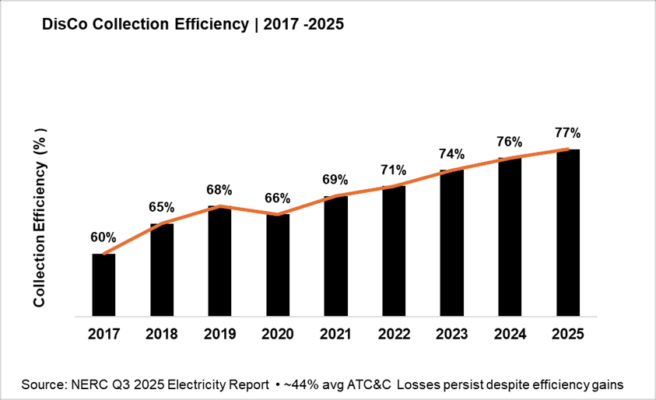
The foundation of NESI commercial instability is the DisCos’ inability to convert delivered electricity into collected revenue. Over the last five years, the system has averaged 44% ATC&C (aggregate technical, commercial, and collection) losses, meaning roughly ₦44 of every ₦100 worth of electricity received by DisCos is not recovered.
Collection efficiency has improved, moving from 60% in 2017 to 77% in 2025, a real and meaningful trend. But the gap is still large enough to destabilise cash flow across the entire value chain. Only 55% of customers were metered as of Q3 2025, creating an unmetered base that is vulnerable to theft and non-payment. Tariffs, meanwhile, remain politically sensitive and persistently below cost-reflective levels.

2. Payment insecurity cascading upstream
Weak DisCo collections translate directly into non-payment upstream. GenCos are not paid on time, or at all. In 2024, FGN gross subsidy obligation reached ₦1.949 trillion ($1.2 billion), a figure that reflects both below-cost tariffs and the gap between what DisCos collect and what the system requires.
The result is a sector that keeps accumulating arrears, not because of bad luck or poor management in isolated cases, but because the commercial structure was never designed to close. The Presidential Power Sector Debt Reduction Programme (PPSDRP) and its ₦501bn inaugural bond, 100% subscribed, are an important milestone: it clears the backlog and signals that domestic capital markets will show up for credible power sector instruments. But it does not address the structural driver of the arrears. Without that fix, the sector risks recreating the problem on a new cycle.
A balance sheet reset is not a system recovery. If the structural drivers of cash shortfalls remain intact, the sector will recreate the arrears in a new cycle.
3. The grid: The constraint no one talks about enough
The third weakness is the one that makes the first two harder to fix and that limits the return on every naira invested in generation. The transmission network suffers from limited wheeling capacity, chronic grid instability, frequent system collapses, and years of underinvestment in redundancy.
The numbers tell the story more clearly than the narrative:

Installed capacity grew from 12,522MW to 13,625MW between 2019 and 2024. Available capacity fell from 6,280MW to 4,854MW over the same period. TCN’s stated wheeling capacity increased to 8,100MW, but in practice, operational constraints mean peak wheeling capability and sustained deliverable capacity are very different numbers. The grid has historically experienced full system collapses. The question of how much can be wheeled consistently without system stress is not the same as the 8.1GW headline figure. The challenge is not building more megawatts. It is building the infrastructure to consistently deliver the megawatts that already exist.
The NETAP lesson: Financing is not the problem
A useful way to test where the real constraint lies is to look at what happened when money was provided. The World Bank-financed Nigeria Electricity Transmission Project (NETAP, P146330) was approved in 2018 with a mandate to increase transfer capacity – substation upgrades, transmission line installation, SCADA & EMS installations.
The project was expected to be completed in 2025. Its closing date has since been extended to June 30, 2026. The reasons are instructive:
Limited outage approvals in a fragile grid – executing transmission upgrades requires taking live, energised assets out of service. In a system operating close to its limits, the system operator cannot easily grant the outages that construction requires.
Coordination friction between TCN, GenCos, and DisCos – each has operational interests that do not align neatly with the construction schedule.
Security and vandalism – repeated theft and damage to OPGW (optical ground wire) fibre, which is critical enabling infrastructure for SCADA/EMS deployment.
Incomplete ‘complementary works’ – SCADA & EMS systems require control centres, RTUs, towers, battery banks, and fibre connectivity. Procurement of the primary systems moved faster than the enabling infrastructure, leaving the SCADA investment unable to function.
Substation rehabilitation and transformer additions progressed materially. Digitisation and operational control lagged. The constraints are systemic, not merely contractual.
NETAP is telling us something important: the problem is not that Nigeria cannot attract financing for transmission. It is that execution is constrained by governance, security, and the fragility of the grid itself.
This reframes the challenge entirely. It is not a capital availability problem. It is a deliverability and commercial architecture problem. And that distinction points directly to what needs to change.
The question that part 2 answers
The FGN’s refusal to privatise TCN is understandable. Transmission is a national security asset. But no privatisation should not mean no private capital.
The question is not whether Nigeria needs investment. It is how to attract it at scale without giving up public ownership. That model already exists, and Nigeria has used it before.
If Nigeria can raise ₦501bn through the capital market to clear a liability, it can raise more to build an asset, provided the structure is bankable.
Part 2 of this series, From Liquidity to Deliverability, sets out the commercial model, the proof points, and the immediate steps Nigeria can take.
Chinelo Ndurue is a commercial advisor with twelve years of experience in the upstream oil and gas sector. She holds B.Sc. and M.Sc. degrees in Petroleum Engineering, as well as an MBA and an MSc in Finance. Her work focuses on the intersection of energy infrastructure engineering and project finance.
Join BusinessDay whatsapp Channel, to stay up to date
Open In Whatsapp