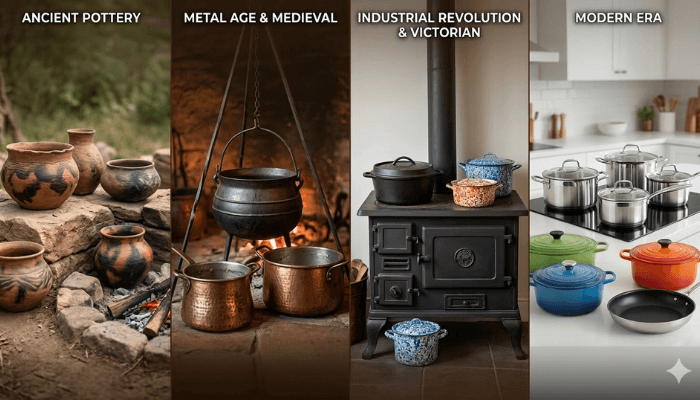
Nearly every civilisation that has ever existed cooked in a pot. That single fact is more revealing than it sounds. The pot has been with us for thousands of years, and every time the world changed, it changed too. New materials, new technology, new ideas about how life should be lived. Read the pot, and you are reading the age that made it.
Here is what thousands of years of cooking vessels tell us about the people who used them.
The first pots — c. 20,000 BC
Archaeologists once assumed pottery was a product of settled farming life. Then came the finds that upended that assumption. Fragments recovered from Xianrendong Cave in China’s Jiangxi province have been dated to around 20,000 years ago, placing the first known cooking pots deep in the last ice age, thousands of years before agriculture existed. Further evidence came from Japan. A University of York study, published in Nature, analysed food residues in Jōmon period pottery up to 15,000 years old and found chemical traces of fish and marine mammals preserved in the clay. These were not farmers with grain to store. They were hunter-gatherers who made pots because they wanted a better way to cook fish — and they figured it out long before anyone thought to plant a crop.
Earthenware and the farming revolution — c. 7,000 BC
In the Near East, pottery and farming did arrive together. When communities across the Fertile Crescent, the Indus Valley, and China settled into agricultural life, the cooking pot became a daily essential. Grain needed storing. Water needed carrying. The earthenware vessels that filled Neolithic homes were simple objects — shaped by hand from local clay, fired at low temperatures, and porous enough that fats from cooking seeped into the walls. That porousness turned out to be useful to us, if not to them. Scientists analysing residues in Neolithic pots from across Europe have found traces of dairy, meat, and plant foods preserved in the clay — a direct chemical record of what people actually ate, and evidence that dairy farming was established in Britain as far back as 6,000 years ago.
Copper and Bronze pots — c. 4,500–1,000 BC
Once metalworking developed, the kitchen began to divide along social lines. Copper conducts heat well, and the Egyptians, Greeks, and Romans all made use of copper and bronze cookware. Metal vessels appear most prominently in elite contexts — some intricately decorated, clearly designed to be seen as much as used. For most households, though, clay remained the material of choice, as it was cheap, widely available, and perfectly adequate for everyday cooking. The gap between who cooked in metal and who cooked in earthenware was not absolute, but it broadly tracked wealth. What you cooked in said something about where you stood.
Cast iron in China — 5th century BC onwards
Cast iron cookware has its origins in China, where simple cast iron utensils were in use from around the 5th century BC. The Han Dynasty, which ran from 202 BC to 220 AD, saw significant advances in iron-casting techniques, and Chinese craftsmen produced durable cooking vessels valued for their ability to retain and distribute heat evenly. The wok — still central to East Asian cooking today — developed from this same tradition. Europe had iron cooking vessels in antiquity, but large-scale cast iron cookware production came considerably later. The technological gap was real — and it is one that tends to get overlooked in Western histories of invention.
The Dutch Oven — Early 18th century
The cast-iron Dutch oven has an unexpectedly specific origin story. In 1704, an English ironmaster named Abraham Darby visited the Netherlands to study the Dutch method of casting metals in sand moulds, which produced a finer surface finish than English techniques of the time. Back in England, he adapted the process for cast iron and in 1707 patented the method. The heavy, lidded cooking pot it produced became known as the Dutch oven — a name that has survived more than three centuries. It proved enormously durable and valuable. In colonial America, cast iron cookware was considered significant enough to be written into wills. Mary Ball Washington, mother of President George Washington, specified her iron kitchen furniture carefully in her 1788 will, itemising which pieces should go to which heirs. A cooking pot, passed down like jewellery.
The Kitchen Stove — Mid-19th century
For most of human history, pots were built for fire. They had legs to stand in the coals, or handles to hang them over a flame. The enclosed kitchen stove, which became widespread in the mid-19th century, changed the pot almost overnight. Legs disappeared. Bases went flat. The cast-iron skillet as we know it today — legless, heavy, and designed for a flat stove top — is a direct product of this moment. American manufacturers such as Griswold, founded in 1865, and Wagner Ware, founded in 1891, began producing cast-iron cookware at scale for a rapidly urbanising population. Cast iron was, by the early 20th century, the dominant cookware material in American homes.
The rise of Aluminium and non-stick — Mid-20th century
Cast iron’s decline did not happen all at once. Aluminium became cheaper and more widely available in the early 20th century and gradually took over as the preferred cookware material. Then, in the 1960s and 70s, Teflon-coated aluminium non-stick pans arrived and accelerated the shift decisively. Lighter, easier to clean, and requiring far less fat to cook with, non-stick pans were the perfect product for an era that prized convenience above almost everything else. The consequences for the cast iron industry were severe. Nearly all the American manufacturers that had dominated for decades either closed or were absorbed by competitors. today, Lodge is the only major cast iron cookware manufacturer still operating in the United States.
Modern Cookware — Today
The contemporary kitchen pulls in two directions at once. Stainless steel and ceramic-coated aluminium represent the continued pursuit of performance and convenience. But cast iron has staged a significant comeback — driven partly by concerns about the safety of some chemical non-stick coatings at high temperatures, and partly by a broader cultural appetite for slower, more considered cooking. The trend accelerated during the lockdowns of 2020, when many people found themselves cooking at home for the first time in years and reaching for heavier, more traditional equipment. The oldest cooking vessels we know how to make are back on the stove. The pot, as ever, knows exactly what era it is in.
Join BusinessDay whatsapp Channel, to stay up to date
Open In Whatsapp