A few weeks ago, while standing in line at Hartsfield–Jackson Atlanta International Airport, the world’s busiest airport I overheard a traveler complaining about a delayed flight.
“Another reroute,” he said, shaking his head. “They said something about airspace issues overseas.”
For most of us in the terminal, it sounded like the usual travel inconvenience—another delay, another announcement over the loudspeaker. But as someone who studies politics and business, I couldn’t help thinking about the larger story behind that moment.
Sometimes the reason your flight is delayed in Atlanta begins thousands of miles away.
I first began thinking about global connections years ago while studying political science at Obafemi Awolowo University. Later, as I moved across continents—from Lagos to the United Kingdom and now to Atlanta for my MBA at Georgia State University—I came to appreciate how much modern life depends on mobility.
Air travel quietly holds our world together.
Students cross continents to study.
Families reunite across oceans.
Businesses grow because people can meet face-to-face.
But lately, the system that makes all this possible has begun to feel more fragile.
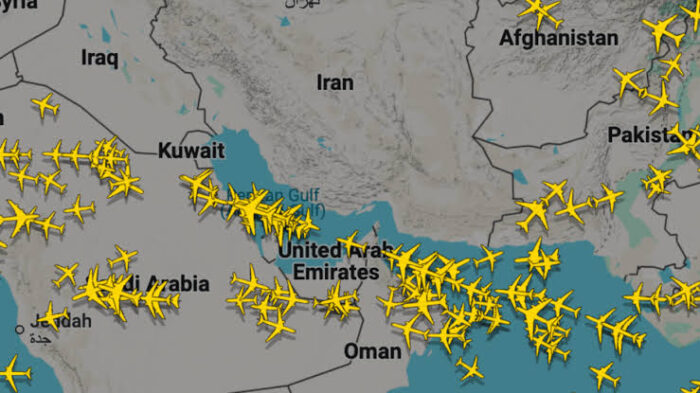
Rising tensions involving the United States, Israel, and Iran are reshaping the routes airplanes take across the world. To most travelers, these geopolitical shifts feel distant. Yet they quietly influence the very paths planes fly.
For decades, the Middle East served as the crossroads of global aviation. Cities like Dubai, Doha, and Istanbul became powerful hubs connecting East and West. Those routes shortened travel times and made the world feel smaller.
But when tensions rise and certain airspaces become risky or restricted, airlines must suddenly redraw the map. Flights that once followed the shortest path are forced into long detours around conflict zones.
What might look like a minor adjustment on a map can mean hours of extra flying time.
For passengers, that often translates to delays, missed connections, and higher ticket prices. For airlines, it means burning more fuel, scheduling longer crew hours, and managing rising costs.
In other words, when geopolitics disrupts the sky, the entire system becomes more expensive.
Even travelers who never leave the United States feel these ripple effects. Aviation runs on fuel, and global energy markets shape fuel prices. When instability threatens oil supply routes like the Strait of Hormuz, the price of jet fuel climbs.
Airlines eventually pass those costs along.
A passenger flying a short route on Delta Air Lines might assume their journey is purely domestic. But the price of that ticket is influenced by events unfolding thousands of miles away in the Persian Gulf.
This is the strange reality of globalization: even the most local experiences are tied to global forces.
Yet the deeper impact goes beyond economics. Travel is more than transportation—it is a connection. Every flight carries students, workers, tourists, and families trying to reach one another.
When routes become uncertain and the cost of travel rises, those human connections begin to feel a little more distant.
For someone like me—who has lived, studied, and worked across multiple countries—mobility has always represented possibility. It allowed a student from Nigeria to study in the United Kingdom, build global experience, and continue his journey in the United States.
But that kind of movement depends on something fragile: a world that remains open.
We often assume the global system will always function smoothly—that planes will fly where they always have and that distance will continue shrinking. Yet the reality is more delicate.
The modern world runs on networks: trade routes, digital connections, and the invisible highways of the sky.
When those networks face strain, we begin to notice something we rarely think about.
The world starts to feel bigger again.
And sometimes, that realization arrives not through a headline or a diplomatic speech—but through a delayed flight announcement in an airport terminal.
Author Bio
Louis Akorede Awode is a writer, social advocate, and emerging leader pursuing an MBA at Georgia State University. A Political Science graduate of Obafemi Awolowo University with a Master’s in International Business and Marketing from University of Dundee, United Kingdom, his work focuses on global affairs, entrepreneurship, and building businesses that scale globally while strengthening local economies. He is the founder of the Louis Awode Foundation and ClovisCasuals.

Join BusinessDay whatsapp Channel, to stay up to date
Open In Whatsapp