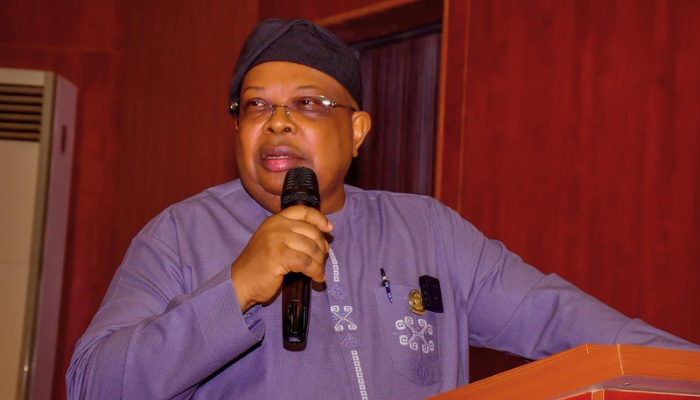
Years of weak revenue generation and dependence on borrowing to finance public spending drove the federal government to embark on its boldest tax overhaul in decades, Dr. Joseph Tegbe, the chairman, National Tax Policy Implementation Committee (NTPIC), has revealed.

Tegbe said the country’s tax architecture had long been characterised by low collections, multiple overlapping levies and a narrow tax base, leaving only a small pool of compliant businesses and individuals to shoulder most of the burden.

Speaking at the BusinessDay Tax Reform Conference 2026, in Abuja on Thursday, he described the new reforms as a “structural reset” of Nigeria’s tax system designed to simplify compliance, reduce taxes for millions of individuals and small businesses, and strengthen government revenue to reduce reliance on debt.

“Nigeria has enacted four landmark legislations that collectively represent a structural reset of its entire tax architecture,” Tegbe said.

“These laws are not incremental adjustments; they are a bold reimagining of how Nigeria raises revenue, administers taxes and delivers value to its citizens.”

The reforms are anchored on four new legislations — the Nigeria Tax Act 2025, Nigeria Tax Administration Act 2025, Nigeria Revenue Service Act 2025, and the Joint Revenue Board Act 2025 — which collectively restructure how taxes are collected, administered and coordinated across the country.

According to Tegbe, the reforms were necessitated by structural weaknesses that limited Nigeria’s ability to generate domestic revenue.

“Nigeria is one of the countries that collect very little tax,” he said, noting that the country’s tax-to-GDP ratio has historically ranged between 6 percent and 10 percent, among the lowest globally.

He compared this with about 26 percent in South Africa, 16 percent in Kenya, and more than 30 percent among countries in the Organisation for Economic Co-operation and Development (OECD).

According to him, the weak revenue base forced the government to rely heavily on borrowing to finance public expenditure.

“When tax collection is low, the government has to rely heavily on borrowing,” Tegbe said.

“This increases national debt and puts pressure on inflation, interest rates and the value of people’s income.”

He explained that the old tax regime also discouraged investment due to policy uncertainty and multiple levies imposed by different tiers of government.

“Investors want to come into Nigeria and the first thing they ask is about the living environment,” he said.

“What they really want to know is: what are the incentives, and what are the levies and taxes.”

Tegbe stressed that a predictable tax system is critical for attracting long-term investment.

“Tax has always existed. It is a civic responsibility. But it has to be simple and predictable. If it is not predictable, that is where people become concerned,” he said.

Beyond low revenue, businesses were also burdened by multiple taxation and overlapping authorities across states and local governments.

“When you move from one state to another, you encounter overlapping authorities and conflicting rules,” Tegbe said.

“The same business can be asked to pay multiple levies across different states.”

The new framework, he explained, seeks to harmonise tax administration across federal, state and local governments while eliminating arbitrary roadside collections and overlapping levies.

Another major challenge, Tegbe noted, was that only a small segment of the economy was actually paying taxes.

“In the past, a small pool of compliant businesses and workers bore the lion’s share of the national tax burden while vast swaths of the economy remained outside the tax net,” he said.

The reforms, he added, aim to widen the tax base while simplifying the system to encourage voluntary compliance.

Under the new regime, most Nigerians are expected to pay the same or even lower taxes, particularly low-income earners and small businesses.

“There is no intention to increase the tax burden on ordinary Nigerians,” Tegbe said.

“The goal is to widen the tax net so that more people contribute while those already complying may even pay less.”

Individuals earning less than N800,000 annually will pay no personal income tax, while nano businesses earning below N12 million annually will also be exempt.

Similarly, companies with annual revenue below N100 million and assets under N250 million will not pay corporate income tax, while corporate income tax has been reduced to 25 percent from 30 percent for larger firms.

He explained that the reforms also remove value-added tax on essential items such as food, medicines, rent and textbooks in a move aimed at easing pressure on households.

A key component of the overhaul is the creation of new institutions to streamline tax administration.

The new framework establishes the Nigeria Revenue Service as the central federal revenue authority and introduces the Joint Revenue Board to coordinate tax administration between federal and state governments.

It also strengthens the Tax Appeal Tribunal and creates an Office of the Tax Ombud to protect taxpayers and resolve disputes.

“Digital tax platforms will play a central role in the new system, with filing, payments and reporting migrated online to reduce human interference, corruption and leakages,” he explained.

Tegbe noted that the reforms are designed not only to improve revenue but also to stimulate investment and economic growth by creating a clearer and more predictable tax environment.

For investors and large companies, the new regime promises fewer overlapping tax demands, stronger dispute resolution mechanisms and improved policy clarity,  longstanding concerns among businesses operating in Nigeria.

Ultimately, Tegbe said the reforms are about building a sustainable fiscal future for the country.

“Tax reform is ultimately about something far larger than revenue collection,” he said.

“It is about building the financial foundation for a stronger, more self-reliant Nigerian economy that can fund its development without perpetual dependence on debt.”

Join BusinessDay whatsapp Channel, to stay up to date

Open In Whatsapp