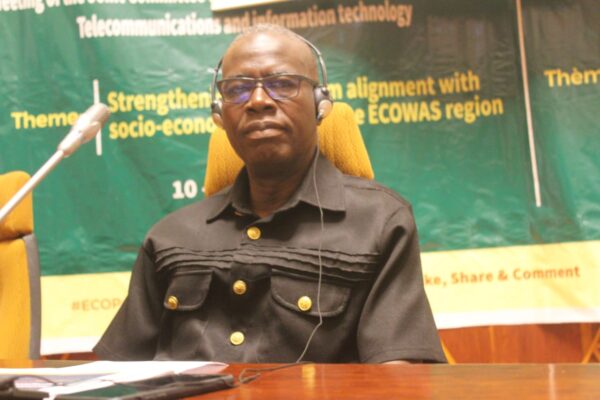
A Liberian lawmaker has urged West African leaders to move beyond rhetoric and take decisive action to reform the region’s education system, warning that failure to equip young people with practical skills could exacerbate unemployment and fuel migration.
Samuel Enders, a member of the Liberian delegation and the Community Parliament’s Joint Committee on Health, made the appeal on the sidelines of a delocalised meeting in Lome, Togo.
Speaking passionately, Enders expressed concern that discussions on education reform may remain purely theoretical without tangible follow-up.
“I hope we would not pay lip service to this. We need to look at the data, look at the facts, and understand the importance of education in strengthening our Community”, he said.
Read also: Top 10 mutual funds return over 35% as of February 2026
The five-day meeting brings together the Parliament’s joint committees on Education, Science and Culture, Health, and Telecommunications and Information Technology.
According to the lawmaker, its theme, “Strengthening curriculum alignment with socio-economic needs of the ECOWAS region,” reflects growing worries that West African education systems are not preparing students for current labor markets.
Enders, who has previously served on an educational committee in Liberia, stressed the demographic reality of the region, a rapidly growing youth population that must be equipped for the future.
“We have a huge number of young people in this sub-region. We need to ensure they are educated, not just academically, but with practical skills that allow them to support themselves and their families”, he said.
The lawmaker highlighted a worrying trend: a direct link between the skills mismatch in education and the increasing number of West Africans seeking opportunities abroad.
“A lot of our population is leaving the sub-region because there are no jobs. They are not equipped; they are not ready for the job market at hand.
“If we can align our education with our economy, knowing what is available, what jobs are needed, and how we can transform our society, we can get our young people working”, he said.
Enders argued that equipping youth with relevant skills is essential for building human capacity, strengthening local job markets, and fostering societal development.
He noted that this would reduce dependence on foreign expertise in critical industries.
“It is very important if we want to keep our young people, strengthen and develop our society, and if we want to be independent and not depend on others for everything needed to advance our countries,” he added.
The lawmaker emphasized that no single country can tackle the challenge alone, advocating for a coordinated, regional approach to assess labor market needs.
“We cannot work in isolation. We should be able to coordinate. We have to look at the job market, understand the needs of our communities and member states, and identify what skills are required”, Enders said.
He cited Liberia’s mining sector as an example, questioning whether the country has enough trained personnel to operate and maintain equipment critical to the industry.
He recalled a conversation with a Nigerian professional in gas production who highlighted the same challenge: a workforce not ready for available jobs.
Enders urged West African nations to see themselves as an interconnected unit, stressing that collaboration benefits the entire region.
“If we notice that our development depends on one another, then we begin working together. If we are going to have new discoveries and technology, we need to work together”, he said.