Over the past year, working around development programmes and partnerships, I began to notice something small but telling.
It did not arrive through an announcement or a policy statement. The shift appeared in administrative places. A proposal template that no longer required a detailed gender plan. A partner conversation that moved quickly past representation and stayed longer on budgets, timelines, and deliverables. A programme originally designed as a year-long cohort shortened because funding cycles tightened.
Nothing stopped outright. But certain expectations quietly stopped being enforced.
Anyone who works around development programmes knows that priorities reveal themselves first in paperwork and funding structures, long before they appear in speeches or policy statements.
A few years ago, gender inclusion was something programmes had to account for carefully. Proposal guidelines asked for it. Reporting templates tracked it. Grants often required evidence that participation had widened. Inclusion was not just good practice; it was a condition of support.
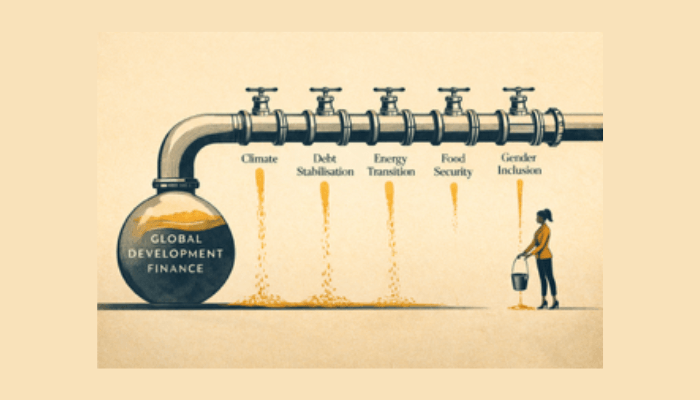
Recently, the emphasis has shifted. Economic pressures — rising debt, inflation, humanitarian crises, and energy shocks — have narrowed the focus of development funding toward stabilisation, food security, and climate resilience. Gender remains acknowledged, but it appears less often as a stand-alone programme priority.
The shift is not only anecdotal. Recent surveys by UN Women show that funding pressures are already affecting the organisations that carry much of this work. Many women-led organisations report scaling back programmes or pausing activities as grants tighten and donor priorities move toward crisis response and economic stabilisation. The issue is not that gender equality has disappeared from policy language. It is that the funding streams that sustained many of the programmes around it have become less predictable.
Participation programmes depend on repetition. Networks grow stronger when new cohorts follow the previous ones. Mentorship works because relationships build over time. Data becomes meaningful only when it is collected consistently enough to reveal patterns.
Remove two or three cycles and the structure weakens. The people remain committed, but the momentum thins.
In Nigeria, this often looks less like withdrawal and more like quiet scaling back. Fellowships take in fewer participants. Research updates pause. Partnerships continue in name but with lighter activity. Organisations prioritise what must run over what ideally should run.
Nigeria also reflects the broader shift in another way. New priorities such as climate transition, food security, and macroeconomic reform are attracting significant attention and funding. Yet analysis of climate finance flowing into the country shows that only a small fraction explicitly prioritises gender equality. The need has not diminished. But as new agendas emerge, inclusion is often treated as an assumed benefit rather than something intentionally designed.
Moments like this raise a useful question about how inclusion has been organised.
For years, much of the progress we celebrated came through dedicated initiatives. These programmes opened doors and demonstrated capability. But they also sat slightly outside the core machinery of economic policy and institutional practice.
When pressure increases, systems protect their central functions first. Anything perceived as additional work begins to compete for attention.
That is why the theme “Give to Gain” deserves a slightly different interpretation this year.
The giving required is not only financial. It is structural.
It means embedding participation into the way institutions operate so that progress does not depend on whether the issue happens to be fashionable or well funded in a given year.
Rules endure better than programmes. Recruitment standards last longer than campaigns. Procurement requirements survive budget cycles more easily than projects.
When access is built into everyday processes, progress continues quietly. When it depends on attention, it moves with attention.
The economic case for doing this is increasingly clear. Women already account for nearly half of Nigeria’s labour force and own more than 40 percent of small and medium enterprises, the sector that contributes roughly half of national GDP. Yet access to finance, leadership pipelines, and high-growth sectors remains uneven. Recent analysis suggests that closing gender gaps in labour participation alone could add as much as $229 billion to Nigeria’s GDP. Across Africa more broadly, research by the McKinsey Global Institute estimates that advancing gender equality could increase the continent’s GDP by around 10 percent. In other words, the gains from inclusion are not theoretical. They are measurable and substantial.
Recent funding shifts are therefore revealing. They do not necessarily mean commitment was insincere. They simply show where inclusion was deeply anchored and where it relied on periodic emphasis.
The distinction matters because development is cumulative. Gains that depend on continuous reinforcement pause easily. Gains built into routine practice keep moving, even when the spotlight shifts.
Economic cycles will always reorder priorities. Stability, recovery, and growth will repeatedly take centre stage. The question is whether participation expands only when conditions are favourable, or whether institutions carry it forward even when the agenda is crowded.
Because development progress becomes durable the moment inclusion stops depending on the priorities of a particular funding cycle.

Join BusinessDay whatsapp Channel, to stay up to date
Open In Whatsapp