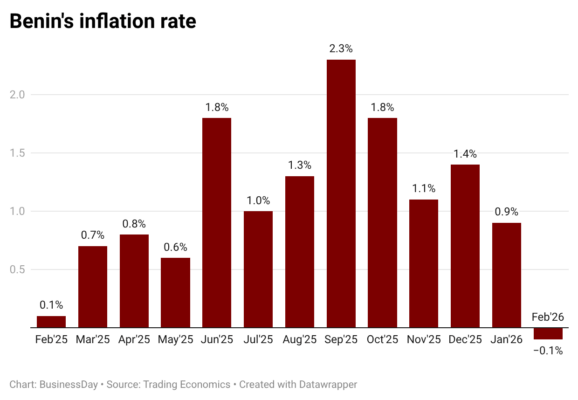
Benin slipped into deflation in February 2026 for the first time in 14 months as falling food and service costs outweighed rising housing and energy prices, according to data released Wednesday by the country’s statistics agency.
The development marks the eleventh time inflation has fallen into negative territory in the past five years, highlighting the volatility of consumer prices in the small West African economy.
Data from the National Institute of Statistics and Demography (INStaD) showed that consumer prices declined 0.1 percent year-on-year, compared with a 0.9 percent increase in January.
Disinflation — often confused with deflation — refers to a slowdown in the pace of price increases. However, Benin’s latest data indicates outright deflation, meaning the overall price level fell, slightly boosting consumers’ purchasing power.
The drop in inflation comes at a time when geopolitical tensions risk reigniting price pressures globally. The ongoing United States–Israel conflict with Iran has pushed up global crude prices, raising concerns that higher energy costs could reverse the recent disinflation trend seen across several African economies.
Many African countries have recorded a steady decline in inflation over the past year, but sustained increases in energy prices could slow or even reverse that progress — particularly for oil-importing economies such as Benin, which relies heavily on imported refined petroleum products due to the absence of domestic refining capacity.
INStaD attributed the drop in inflation mainly to lower prices in key consumer categories, especially food, transport and hospitality services.
“The annual decrease was particularly favoured by the reduction in prices in the divisions of food products and non-alcoholic beverages, transport, and restaurants and accommodation services,” the statistics agency said.
Food prices — which carry the largest weight in Benin’s consumer basket — declined 0.2 percent compared with February 2025. Transport costs dropped 1.9 percent, while prices for restaurants and accommodation services fell sharply by 5.6 percent.
Fresh food products also became cheaper, declining 0.7 percent year-on-year, suggesting improved supply conditions in local markets.
Mixed price pressures across sectors
Despite the overall drop in consumer prices, several sectors continued to record rising costs.
Energy prices increased 3.9 percent, while housing-related costs rose 6.5 percent. Health services prices climbed 2.1 percent, and leisure and cultural services increased 5.3 percent.
According to INStaD, these increases were not enough to offset the broader decline in food and service prices.
Sectoral data highlighted diverging price trends across the economy. Prices in the primary sector fell 2.7 percent, while those in the secondary sector rose 2.4 percent. In the tertiary sector, prices declined 1.9 percent.
Despite the negative annual reading, monthly prices remained stable. The consumer price index stood at 101.6 in February, unchanged from January, indicating that the overall price level remained broadly flat on a month-to-month basis.
Deflation remerging in parts of Africa
BusinessDay analysis shows Benin joins a small but growing group of African economies that have recorded negative inflation readings over the past year.
Morocco’s consumer price index fell 0.8 percent year-on-year in January 2026, extending a 0.3 percent decline recorded in the previous two months.
Burkina Faso also experienced deflation, with inflation dropping to –2.2 percent in December, the sixth negative reading recorded in recent months.
Algeria briefly entered deflation in June 2025, when prices fell 0.22 percent, before returning to positive inflation of 1.5 percent in November.
The scattered deflation readings reflect easing food prices, currency stabilisation and tighter monetary policy across parts of the continent, although the trend could face renewed pressure if global energy prices continue to rise.

Join BusinessDay whatsapp Channel, to stay up to date
Open In Whatsapp