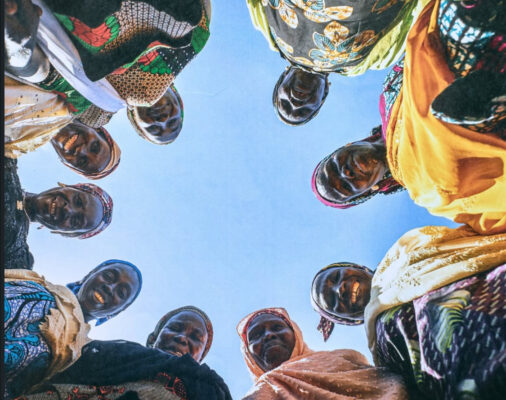
The award-winning Nollywood documentary Mothers of Chibok, directed by Joel Kachi Benson and executive produced by Joke Silva, has extended its impact far beyond the cinema screen by catalyzing real economic change for the Chibok mothers it portrays.
In a recent BusinessDay interview, Benson and Silva explained how the film’s observational storytelling, focusing on the women’s resilience, farming lives, and full womanhood rather than solely grief, sparked an intentional strategy to improve their livelihoods: providing better seeds and fertilizer led to dramatic yield increases.
This has evolved into value addition through partnerships that process raw groundnuts into peanut butter, groundnut oil, and other products under the emerging ‘Mothers of Chibok’ brand, sold in places like Gather House in Ikoyi, with profits flowing back to the community to foster stability, fund education, and scale support for the women.
Interviewer: Tell me about this particular documentary. How did it come about? What was the inception of this documentary? What drove you to make this film?
Kachi Benson: Mothers of Chibok is a spiritual sequel to Daughters of Chibok. Daughters of Chibok is a virtual reality film that I made in 2018, premiered at Venice in 2019, and subsequently won the Venice Lion. And when it did that, it drew a lot of attention to the community and obviously to my work and what I was trying to do. I think I would like to define myself as a social impact storyteller.
So I like to see how film intersects with social impact, and you can use film intentionally to bring change. So when we did Daughters of Chibok, we tried to do some stuff in the community. Give the women solar home systems, fertilizer, seeds for their farms, all that stuff. And then I started to spend more time with them doing that. And the more time I spent with them, the more I realised that Daughters of Chibok wasn’t the complete story.
I had reacted or responded to something that I was confronted with, which was the grief of these mothers. But then, looking beyond the grief, you begin to see other things. You begin to see resilience, courage, strength, hope, beauty, and humor. And I said to myself, oh, wait a minute, I didn’t tell the complete story. And I have to go back and tell the complete story because it’s important that this side of these women are seen.
I cannot, as a Nigerian filmmaker based in Nigeria, have access to these women and this story and contribute to the reduction of their lives just to a headline.
As of 2021, I went back to Chibok and started to make this film. It took us about three years to make. But really, it was about presenting the mothers of Chibok through the lens of dignity, strength, and faith, and everything else that makes up who they are.

Interviewer: Ajoke Silva, what made you interested in this particular documentary and this project? What drove you into it, and why did you accept to join Kachi in this project?
Ajoke Silva: The story of the abduction of the Chibok girls is a national wound that we all know about. Various people have done what they can. There was the initial stage where a lot of people, there was the Bring Back Our Girls movement. And there’s a beautiful refusal of not letting it go into forgetting that’s been done at Falomo Roundabout by Bony Alakija, the painting of the girls on the pillars. But whether we like it or not, the world moved on.
Kachi got a very good friend of mine, Mr. Femi Odubemi, and they both invited me to come watch the film. And I felt that this was a passing on of the baton to then look beyond the abduction.
The focus had been on the abduction, and what are we doing to get the girls back? But in that space of getting the girls back, who are the people holding the fort? And what Kachi’s film does absolutely brilliantly is that he lets us see the generals. They’re not soldiers. They’re not foot soldiers. They’re generals holding the fort and building a community that has been emotionally shattered.
He does it with his camera as an observer. So it’s the women who tell the story. So we, the onlookers, get to sit in with them as they unfold the story of their maintenance of living, they share. So it’s a maintenance of living shared that Kachi serves us.
There’s no way that you watch that film and you don’t have an immediate paradigm shift, whether it’s in faith, whether it’s in resilience, whether it’s in your definition of what dignity is, whether it’s in your definition of what work is, whether it’s in your definition of how important education is.
I feel honored to be asked to be part of it.
Interviewer: Kachi, do you share the same feeling with Auntie Joke after you spent a lot of time with these women?
Kachi Benson: It was a very observational style of filmmaking that I adopted. It wasn’t a case of flying in, shooting some B-roll, flying out, and saying we’ve made a film. We really wanted to immerse ourselves in the lives of these women up to the point where we became almost like family.
Like a fly on the wall approach, just there with a camera. Some people who have seen it have said that it’s a very immersive experience. You’re so immersed in this world, and in observing, you hear the women speak in their own words and tell their own story.
What drew me to it, as I said, is that there were other sides to these women that I saw. And I was like, the world needs to see this. We’re not doing service to the mothers or to the story by presenting them always through this lens of the abduction or the kidnapping or grief, and sort of like making them the poster women for abduction.
Whereas when we see them in their full element, in their full womanhood or motherhood, you suddenly come away feeling a sense of admiration for them as opposed to pity. And so, as a storyteller, you always want to tell as much of a complete story as you can.
The tagline that we use for the film is “if you think you know the story, think again.” That’s what you come away with after watching it. You’re like, oh, wow, these women are unbroken. And as much as the media has been used in the past to present them in this sort of broken, grieving state, what ‘Mothers of Chibok’ has succeeded in doing is to present a different narrative.
Interviewer: Film is a business. How was producing this documentary? How was the film financing? What was the budget?
Kachi Benson: I initially started just bootstrapping, figuring things out. There’s a lot of IOUs with my team. My DP is based out of Johannesburg. So every time I would have to fly in. It was a pretty expensive film to make. I think we’re looking at about upwards of about 900,000 to a million USD to make the film.
For me, it was very important that it was done to the highest level possible. I was very fortunate to find producers who believed in what I wanted to do and were willing to support me to do it. There was a certain editor that I wanted to work with, who’s an amazing editor, probably one of the best documentary editors in the world, Charlotte Fungsten, who’s based in Copenhagen.
I remember we spoke to her, and we shared the story with her, and she said yes. Then I shared it with Aunty Joke, and she agreed with everything. I wanted the film to be edited by women and mothers. And so the film was edited by two moms.
The guy who did the sound design was an Oscar-nominated sound designer. The music score was composed by Cobham. So every step of the way, we made sure that we were working with the best. We are hoping that this will actually break even at the cinema.
Interviewer: How were you able to pitch this movie to the cinemas and to be distributed by FilmOne? What was their opinion about it?
Kachi Benson: The same way I approached Auntie Joke was the same way I approached Ladun of FilmOne. It was a shot in the dark. We felt that it was important for a film to be viewed communally, and so we felt like a cinema experience would be great for the film.
From a filmmaking point of view, as a documentary filmmaker, it’s also something that hasn’t quite been done before. After I pitched the film to FilmOne and gave them the movie to watch and review, they came back to me, maybe a couple of weeks later, and said they liked it. So that’s how we got it in the cinemas. It seemed pretty straightforward.
Interviewer: How does this movie help the Mothers of Chibok economically beyond the cinema revenue and into their business and livelihood?
Ajoke Silva: The endgame for the film is the fact that it impacts the lives of the women. And to do that, what Kachi has done is to make sure that they work with an organization now, to get them better seeds and then get them fertilizer so that their yield improves from one planting season to the next.
The first set of women was about 10 women as a group. We are moving from 10 and then scaling to a hundred, and then over five years, we’re going to have a thousand or more, which would have been impacted by this work. Now that yields are better, groundnuts do not remain groundnuts. The corn does not remain corn. So they are being made into peanut butter, being made into groundnut oil, being made into a kind of popsicle or popcorn, and the women benefit from that.
You’ll find some of their produce in the Charter House, Gather House at Ikoyi. It is possible that the Mothers of Chibok brand represents resilience, that represents dignity, and education. These are the brands that have been created from the stories of these women, and by God’s grace, are going to become an international brand.
Kachi Benson: This is one of the very first times that there is an intentional strategy around taking this kind of story and then birthing a brand out of it, where the profits go back into the community.
It started off with making a film that reframes how we see these women. And then, towards the end of production, I realized that the harvest of these women isn’t really that great. Can we work with them and see how we can even just work with them to increase their harvest? And we did all the test studies and all the pilot studies and everything.
They recorded about a hundred percent increase in their yields over the year. One of the women actually in 2024, her yield of three bags. In 2025, her yield was 29 bags.
We have offtakers in Lagos who are willing to offtake. Then we got into processing the raw peanuts. We want to keep extracting more value out of this so that at the end of the day, the women can earn more. We’re very positive that Mothers of Chibok can become this international brand that represents hope and resilience. That out of the ashes of Chibok and pain and this tragedy, something beautiful can come out of it that we can all participate in.
Interviewer: During opening weekend, the movie made over N25 million at the box office. How do you think the audience can join in supporting the women and Mothers of Chibok?
Ajoke Silva: First of all, we want them to go to the cinemas and watch. That for me is very critical. It’s critical because we need to prove to our distributors that the appetite of the audience is not limited to a particular genre. There is an audience for different kinds of film. And the more people go to watch a film like this, the better.
So what I would like to say to the audience is that each person should take three people and tell those three people that they must take three people. And it will keep moving like that across Nigeria and Ghana.
For one woman, through the planting season, for all the things that they need through the planting season to the harvesting, it costs 1.5 million for each woman. So if a couple of people want to band together and support one woman, that would be so appreciated because we’ve gone past the pilot stage. We’re now in the scaling stage. And so we hope that by the end of 2026, we will have 100 women who have been impacted.
I am also hoping that the business community will see the opportunities that are available for investment. The end goal really is to get to the point where the enterprise funds the work. And there’s no need for the charity. Investors should take a look at the model and see where they can come in.
Kachi Benson: Right now, this has been a very interesting organic growth, and now there’s an enterprise conversation around it, where people can taste, touch, and feel the products. We have the foundation that has been working very closely with the women. It’s called the Uwo Siroda Foundation. And then on the other hand, we have this enterprise entity or vehicle that we would like to use to ensure that the most value can be extracted from what these women harvest and then take it back into the community.
We’re currently in conversations with very reputable companies that are in the groundnut processing space. I kind of feel like the best kind of profit to make is a profit that has an impact with it. If you want to find out more about the mothers, what they’re doing with their farming and their enterprise, just go to mothersofchibok.com. All the information is there: how to support, how to donate, and where to watch the film.
Interviewer: For someone who is hearing about Mothers of Chibok for the first time, what would you say to encourage them to go and experience this film in the cinemas?
Kachi Benson: For anyone who’s interested in stories out of Nigeria, for anyone who’s interested in exploring that story, for anyone who’s interested in stories about womanhood and motherhood and the strength of the woman, I think this is a perfect story for that.
We did our best to create a film that really elevates and dignifies these mothers, and we tried to do it at the best possible quality that we could aim for. By the end, I think you come out of it with a sense of respect and admiration for these women, which is how we feel about them. Let’s go watch it and make a statement by watching it.
I would say that it’s great that a documentary film is playing in cinemas in Nigeria. Who would have thought about that five years ago? Three years ago, two years ago, maybe even last year. But here we are. And I think it speaks to the courage of the film distributor who was willing to try with this. But on the other hand, it also speaks to the appetite of the Nigerian audience, younger cinema goers.
Interviewer: Finally, can you both give your takes on how the industry has been in recent years and how it ties into the record breaking release of the Documentary ‘Mothers of Chibok’?
Ajoke Silva: Mothers of Chibok has come out in the cinemas at the right time. It has come out at a time when it seems as if all the distribution outlets (Streaming Platforms) are shutting down. But actually, what it does is that it says very loudly to our country and to our continent that it’s time for us to not only build our own platforms, our own distribution platforms that we own.
Secondly, Mothers of Chibok expresses this brilliantly in the sense that creativity and business have to work together. The dreamers, the imaginators, need to work with those who are business-oriented. The business people have got to learn the language of the artistic creatives and the artistic, so that the artistic creatives can do what it is that they are wired to do. Give good quality work and let the business stop being a spectator and be a partner in the development.
That way, we will find that an industry that can be the soft power for our nation and that can help in the further evolution and development of the nation is given wings, and is given wind beneath its wings to fly.
Join BusinessDay whatsapp Channel, to stay up to date
Open In Whatsapp