

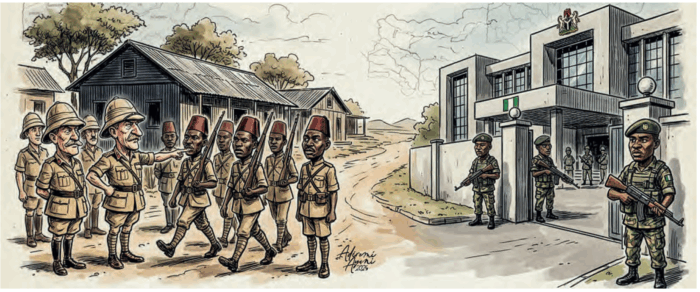
Recent reports of approximately 100 U.S. troops deployed to Nigeria under counterterrorism cooperation frameworks have raised important questions about the evolving architecture of security partnerships between Nigeria and foreign nations. Although numerically modest, any foreign military presence carries political and strategic implications. Military deployments, however structured, reflect broader alignments within global security and energy systems. These developments have unfolded alongside statements from President Trump describing Nigerian violence in explicitly religious terms, a framing that sits uneasily with the country’s more complex conflict realities in which both Muslims and Christians have suffered from insurgency.
Instability did not begin with contemporary insurgency. It is embedded in the institutional logic of the Nigerian state itself. Colonial security doctrine was structured around control and extraction rather than participatory governance. Administrative centralisation, indirect rule, and coercive policing were calibrated to secure territory and resource flows to Europe, not to cultivate inclusive political legitimacy. Post-independence Nigeria inherited much of this command-oriented architecture. Centralised fiscal authority persisted. Borders constructed for imperial administration remained internally fragile. Regional development imbalances widened as political competition intensified. Contemporary insecurity therefore reflects institutional continuity as much as episodic breakdown.
In post-independence Nigeria, the economy was regionally diverse until Niger Delta oil expansion shifted this balance. Joining OPEC in 1971, Nigeria’s oil revenues came to dominate exports and government income, leading to fiscal centralisation, regional dependency, and security reprioritisation. This transformed the country into a petro-state deeply integrated into global energy markets. The Niger Delta illustrates the convergence of oil, marginalisation, and coercive response. Environmental degradation and perceived revenue inequities generated militant resistance. The federal government responded by expanding military protection of oil facilities, prioritising extraction stability over distributive reform. In political economy terms, the state’s coercive apparatus aligned with the protection of rent-generating assets, a pattern characteristic of petro-states.
Although the United States has significantly increased domestic energy production in recent years, Nigeria remains relevant within global oil and liquefied natural gas markets. Disruptions in Nigerian output influence international price stability and European diversification strategies. Energy corridors require security architecture, including maritime patrols in the Gulf of Guinea, intelligence sharing, counterterror coordination, and infrastructure stabilisation. Within that framework, even a limited deployment of approximately 100 troops participates in a broader geopolitical logic framed around stabilising regions central to energy flows and counterterror containment. This does not imply occupation or loss of formal autonomy. It does, however, situate security partnerships within asymmetrical global power structures that shape their terms and consequences.
When Nigerian violence is framed externally as primarily religious persecution, domestic complexity is reduced to a simplified moral binary. Such framing influences international policy debates, donor priorities, and the justification of security engagement. Sovereignty in postcolonial states is layered, encompassing formal independence, economic integration into global markets, and security partnerships embedded within unequal power hierarchies. As Kwame Nkrumah observed, neo-colonialism rarely operates through direct rule; it operates through structural dependence. Even when security cooperation is formally consensual, such consent exists within a global hierarchy of military capacity, financial leverage, and energy market influence. The core issue is not simply the existence of cooperation, but who determines its scope and direction.
Northern Nigeria’s instability intersects with a wider Sahelian arc spanning Niger, Chad, Cameroon, and beyond. Colonial borders bisected precolonial trade and social networks, facilitating contemporary cross-border insurgency. Global counterterror doctrine overlays this geography. U.S. engagement in Nigeria must therefore be understood within a broader Sahel stabilisation strategy. Yet two decades of heavily militarised counterterrorism across the Sahel have produced ambiguous outcomes. Armed groups persist. Governance deficits endure. Civilian displacement has expanded. Militarisation without structural economic reform risks reproducing the instability it seeks to contain.
Nigeria’s political economy reflects three enduring constraints: borders designed for imperial administration, an economy centralised around volatile oil rents, and security institutions oriented towards stabilisation rather than structural transformation. Foreign military presence intersects with all three. If oil revenues are externally priced, if security training is externally structured, and if crisis narratives are externally framed, sovereignty remains formal yet constrained. This is the paradox of the petro-postcolonial state.
The framing of Nigerian violence and the deployment of foreign troops are not anomalies; they are contemporary manifestations of longer structural alignments between energy geopolitics and security governance. Structure, however, does not eliminate agency. Nigeria faces a strategic choice. It can continue operating within a global architecture that prioritises extraction stability and counterterror containment. Alternatively, it can leverage oil wealth towards diversification, strengthen regional African-led security cooperation, reform fiscal federalism, and deepen citizen-centred accountability.
The central political economy question now is not the mere presence of foreign troops. It is whether Nigeria defines the terms of its integration into global energy and security systems or those systems continue to define and constrain Nigeria. Sovereignty is not a slogan. It is the capacity to negotiate from strength, and that capacity is built less through military alliances than through economic diversification, institutional credibility, and the political will to align security with citizen welfare, rather than extraction alone.

Join BusinessDay whatsapp Channel, to stay up to date
Open In Whatsapp


