Escalating tensions in the Middle East are threatening to disrupt Africa’s emerging monetary easing cycle just as inflation begins to ease across much of the continent.
The joint US–Israeli operation that killed Iran’s Supreme Leader, Ayatollah Ali Khamenei last weekend, has heightened geopolitical risks and triggered a sharp rise in global energy prices — developments that could force African central banks to delay further interest rate cuts.
Higher oil prices risk reviving inflation pressures and weakening local currencies, potentially complicating policy decisions across several frontier markets.
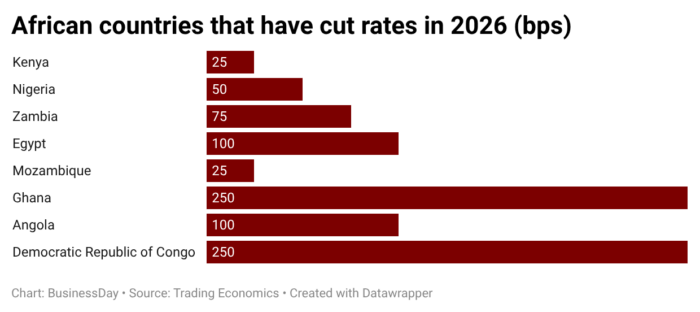
In the first two months of the year, at least eight African central banks — Ghana, Nigeria, Kenya, Egypt, Zambia, Democratic Republic of Congo, Angola and Mozambique — cut interest rates, encouraged by moderating inflation and stronger domestic currencies.
But the improving macro backdrop is now facing a fresh external shock.
Since Friday, Brent crude, the global oil benchmark, has surged nearly 16 percent to around $83.06 per barrel, its highest level in four years, following attacks on vessels near the Strait of Hormuz — a critical maritime corridor that carries roughly one-fifth of global oil flows.
Analysts warn crude prices could climb above $100 per barrel if the conflict widens or shipping disruptions intensify.
Natural gas markets have reacted even more sharply. Prices jumped nearly 50 percent after QatarEnergy halted production following reported military attacks on its facilities, highlighting the fragility of global energy supply chains.
According to SBM Intelligence, about 20 percent of global oil consumption passes through the Strait of Hormuz.
“Closure of the strait, even temporarily, would send oil prices toward unprecedented levels with devastating consequences for import-dependent economies across Asia and Africa,” the research firm warned.
Rate cuts face new risks
The surge in energy prices could complicate the policy outlook for African central banks that had begun shifting toward monetary easing after two years of aggressive tightening.
Until the geopolitical outlook becomes clearer, central banks may adopt a more cautious stance.
“Significant policy rate decisions may be deferred,” said Hasnain Malik, a Dubai-based emerging markets equity and geopolitics strategist at Tellimer, in comments to Bloomberg.
According to Malik, Egypt, Kenya and Morocco are likely to be more vulnerable to economic disruption from rising oil prices than commodity exporters such as Ghana, Nigeria and South Africa.
Some African central banks have already adopted a wait-and-see approach.
- WORLD IN BRIEF: Anti-Trump protests spread nationwide, France foils Bank of America bomb attack, Belgian diplomat contests Lumumba trial and other stories
- World Cup: Italy’s sports minister rejects proposal to replace Iran
- WORLD IN BRIEF: East Africa plans refinery with Dangote, UK jails HIV offender, Meta cuts jobs for AI push and other stories
Uganda, South Africa, Tanzania, Namibia and Botswana kept their benchmark rates unchanged at 9.75 percent, 6.75 percent, 5.75 percent, 6.50 percent and 3.50 percent, respectively.
Rwanda has taken the opposite path. The National Bank of Rwanda raised its policy rate to 7.25 percent from 6.75 percent, the largest increase in nearly three years, as it moved to contain near-term inflation pressures.
Before the latest geopolitical escalation, markets had widely expected further easing across parts of Africa.
Kenya and South Africa’s central banks were both seen as likely to cut rates in the coming weeks. However, the surge in oil prices may now force policymakers to pause.
In South Africa, interest-rate derivatives are now pricing in no chance of a rate cut at the March 26 central bank meeting. As recently as last week, traders had priced in a 32 percent probability of a 25-basis-point reduction.
Speaking in an interview on Bloomberg Television in London on Thursday, Enoch Godongwana, the country’s finance minister warned that the recent surge in global oil prices could place renewed pressure on inflation,
Godongwana noted that Africa’s biggest economy has limited influence over global fuel prices, describing the country as a “price taker” in international energy markets. Sustained increases in oil prices, he said, could translate into higher domestic inflation, particularly if the conflict persists for several weeks.
In January, headline inflation slowed to 3.5 percent in January, supported by softer food and fuel prics.
Capital flows could shift
Beyond monetary policy, rising geopolitical risk could also affect investor flows into frontier markets.
Periods of global uncertainty typically push investors toward safe-haven assets such as US Treasuries and gold, potentially drawing capital away from emerging and frontier markets.
According to Gergely Urmossy, emerging markets strategist at Societe Generale, countries such as Egypt and Kenya could be among the most exposed to shifts in investor sentiment.
However, African frontier debt has performed strongly so far this year.
Dollar-denominated bonds from Senegal and Gabon have recorded some of the highest returns among emerging markets, as investors rotate out of US assets in search of higher yields.
Data from Bloomberg EM USD Sovereign Index shows that Senegal’s bonds have returned 10.4 percent so far this year, while Gabon’s have gained 8.2 percent, trailing only Lebanon among emerging-market sovereign debt.
Join BusinessDay whatsapp Channel, to stay up to date
Open In Whatsapp