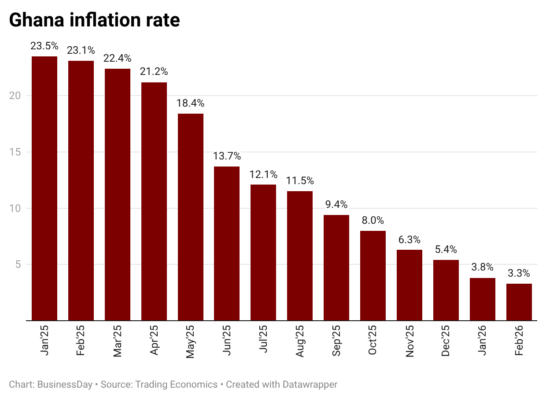
Ghana’s annual inflation slowed to 3.3 percent in February 2026, down from 3.8 percent in January, marking the 14th consecutive month of easing price pressures, according to data released by the Ghana Statistical Service on Wednesday.
The latest reading is the lowest since August 1999, supported largely by the continued strength of the cedi and moderating food prices.
Food inflation declined sharply to 2.4 percent from 3.9 percent in January, while non-food inflation edged up slightly to 4.0 percent from 3.9 percent. On a monthly basis, the Consumer Price Index (CPI) rose 0.8 percent, compared with a 0.2 percent increase in January.
“The steady drop in inflation from 23.1 percent in February 2025 to 3.3 percent in February 2026 shows a sustained shift in prices, signalling a firm path toward macroeconomic stability,” said Alhassan Iddrisu, government statistician, during an online briefing.
The continued disinflation comes as the Bank of Ghana accelerates its monetary easing cycle.
At its first Monetary Policy Committee (MPC) meeting of the year, the central bank cut the benchmark policy rate by 250 basis points to 15.5 percent, the lowest level since February 2022 and below most economists’ expectations.
The move extends one of the most aggressive easing cycles on the continent. The policy rate had already been reduced by 1,000 basis points — from 27 percent to 18 percent — between January and November last year.
The Bank of Ghana is expected to hold its next MPC meeting later this month.
Despite the national decline in inflation, regional disparities remain pronounced.
The Savannah Region recorded the lowest year-on-year inflation rate at -5.6 percent, indicating falling prices, while the North East Region posted the highest rate at 8.9 percent. Five regions recorded inflation levels above the national average of 3.3 percent.
Greater Accra, which carries the largest weight in the national CPI basket at 28.5 percent, recorded inflation of 4.8 percent and contributed 41.5 percent to overall inflation. The Ashanti Region accounted for 24 percent of the contribution, while the Eastern Region contributed 19.2 percent.
Iddrisu attributed the regional differences to variations in local supply conditions, transportation costs and market access.
“Sharp regional differences persist as inflation remains uneven across the country,” he said. “Local supply conditions, transport costs and market access could be driving these gaps.”
With inflation easing significantly, the statistician advised businesses and households to take advantage of the improved price environment.
He noted that companies now have room to invest in operational efficiency, strengthen local supply chains and reduce inefficiencies, which could help stabilise prices further.
For households, he recommended using the period of lower inflation to plan budgets more carefully and build savings buffers.
“This is the time for households to track spending on food, rent and school fees, avoid non-essential expenses and set aside small savings whenever possible to strengthen their finances,” Iddrisu said.
Join BusinessDay whatsapp Channel, to stay up to date
Open In Whatsapp