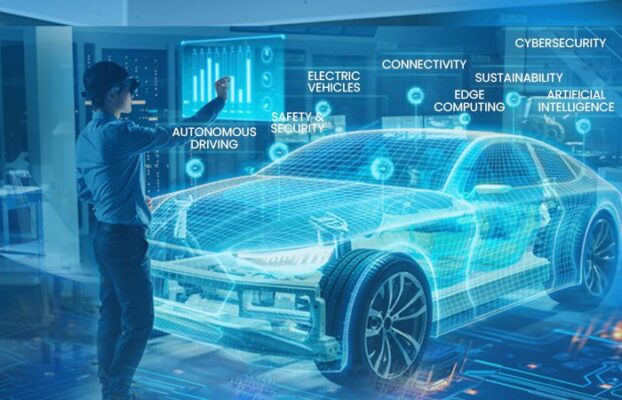
The global automotive space is witnessing a wave of innovations, from technology to electric vehicles, reshaping the ecosystem of mobility.
The industry has evolved from the traditional petrol car to tech-built vehicles, driven by Artificial Intelligence (AI), software, hardware, and electrification, which focuses on enhancing car experiences by providing smart and sustainable options.
With features including Level 3 and 4 autonomy, using AI to manage complex driving, 5G-enabled V2X communication, making cars become talking supercomputers, traditional dashboards replaced by large, high-resolution screens for infotainment, facial recognition and fingerprint scanning used to unlock vehicles and instantly adjust personalised settings, amongst others.
Read also:China’s $143bn bet to lead the Global EV industry
In no particular order, here are five key innovations reshaping the global automotive industry.
Driverless cars
Driverless cars, as the name implies, are vehicles equipped with technology that allows them to operate without direct human input.
Also known as autonomous vehicles, uses features like sensors, cameras, radar, and AI to navigate without human input, aiming to increase safety by reducing human error. They use a combination of hardware and software systems to perceive their environment, make decisions, and navigate roads safely, and these vehicles come in different levels.
While fully autonomous vehicles (Level 5) are not yet widespread, they are designed to detect traffic, pedestrians, and hazards, with key benefits including fewer accidents, better traffic flow, and increased mobility, but challenges remain in handling unpredictable behavior and severe weather.
Companies leading the development of this technology include Waymo, Tesla, Baidu, Cruise, and Zoox.
Flying cars
Flying cars, also called eVTOL (electric Vertical Takeoff and Landing) vehicles, are designed to blend road travel with flight to bypass urban congestion. This era is unfolding in 2026, with transitioning, moving faster from concept to reality than ever, blending automotive with aviation technologies in ways that seemed impossible.
They generally use electric propulsion, feature vertical takeoff, and are anticipated for both personal use and air taxi services within the next decade. Key players include Alef Aeronautics, Klein Vision, Aska, Doroni, Xpeng, Aeromobil, and Samson Sky.
Motorhomes
Motorhomes are self-contained vehicles combining transportation with living quarters (kitchen, bathroom, beds), ideal for flexible and long-term travel.
Key considerations include choosing between Class A (large), B (campervan), or C (mid-size) based on space needs.
Motorhomes range from compact campervans to large coach-built vehicles, often based on vehicles like the Fiat Ducato or Mercedes Sprinter.
Motorhomes are a great way to explore long-haul road trips. However, it’s important to be aware of the costs involved in running a motorhome, so that you can budget accordingly and avoid any surprises along the way.
Electric vehicles
An Electric Vehicle (EV) uses electrical energy as the primary source of propulsion. They come in Plug-in Electric Vehicle, typically a Battery Electric Vehicle (BEV), which only uses energy stored in on-board battery packs, Plug-in Hybrid Electric Vehicle (PHEV), Range-Extended Electric Vehicle (REEV), and Fuel Cell Electric Vehicle (FCEV), which can convert electric power from other fuels via a generator or a fuel cell.
Compared to conventional Internal Combustion Engine (ICE) vehicles, electric cars are quieter, more responsive, have superior energy conversion efficiency, and have no exhaust emissions, as well as a typically lower overall carbon footprint from manufacturing to end of life.
Swimming cars
Swimming cars, also known as amphibious vehicles, are designed to operate both on land and in water. These vehicles range from historical, mass-produced models to modern, high-performance concept cars and emergency-capable luxury SUVs.
Two main categories of amphibious vehicles are those that travel on an air cushion (Hovercraft) and those that do not. Among the latter, many extend the off-road capabilities of land vehicles to all kinds of terrain, including ice, snow, mud, marsh, and swamp.
They are designed for dual-mode transportation, and due to complex engineering, specialised amphibious cars often cost as much as luxury sports cars, leading to low sales numbers.
Join BusinessDay whatsapp Channel, to stay up to date
Open In Whatsapp