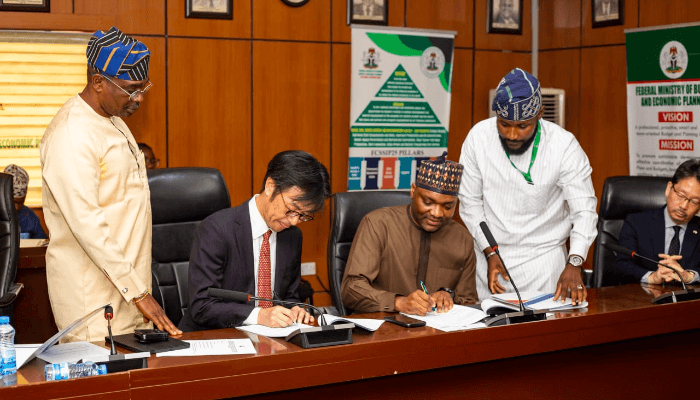
The Nigeria Sovereign Investment Authority (NSIA) and the Japan International Cooperation Agency (JICA) on Friday finalised agreements to establish a $50 million impact innovation fund designed to provide patient, local-currency financing to startups tackling social and infrastructure deficits across key sectors.
The fund will target pre-seed, seed and early-stage ventures in agriculture, healthcare, education, energy, waste and water management — sectors seen as critical to productivity, job creation and long-term economic resilience.
JICA is providing $14 million in grant funding, while NSIA will commit up to $20 million in matching capital. The structure is designed as a first-loss vehicle to de-risk investments and crowd in additional private funding over time.
Read also: FG, Japan launch $50m impact fund to back social startups
Nigeria’s startup ecosystem has expanded rapidly in the last decade, but access to long-term capital — particularly in local currency — remains thin, with most funding concentrated in foreign-denominated venture rounds exposed to exchange-rate volatility.
Umar Aminu-Sadiq, managing director and chief executive officer of NSIA, said the vehicle was structured deliberately to address that structural weakness.
“The fund represents a transformative step for Nigeria’s startup ecosystem. By providing early-stage ventures in high-impact sectors with the capital and support they need to grow, we are enabling innovators to tackle some of Nigeria’s most pressing challenges. Our collaboration with JICA underscores our commitment to entrepreneurship, inclusive growth, and sustainable development,” Aminu-Sadiq said at the signing in Abuja.
Beyond equity capital, the fund will provide technical assistance to portfolio companies, helping founders strengthen governance, refine products and expand market reach — a recognition that capital alone is insufficient in fragile early-stage environments.
Aminu-Sadiq explained that the blended design allows grant capital to absorb initial losses, thereby reducing risk for other investors.
“The combination of NSIA and JICA under the leadership of the ministry offers that. You have a grant capital, which serves as the first loss from JICA facilitated by the ministry. You have matching capital from NSIA and off the back of that, you have our ability to raise significant additional capital,” he said.
While the $50 million launch size provides an anchor, NSIA signalled that scale remains the ultimate objective in an economy of Nigeria’s size.
“The minimum has to be 200 [million dollars]. So we have to keep going until we get to 200 in order to make or to move the needle for an economy like Nigeria,” Aminu-Sadiq added.
Abubakar Atiku Bagudu, minister of budget and economic planning, said the agreement was part of a broader reset in Nigeria’s engagement with development partners — one that emphasises investment and private-sector participation rather than traditional aid flows.
“We don’t want help alone. We want partnership, we want more Japanese companies, more Japanese capital to come
to Nigeria,” Bagudu said at the event.
He expressed confidence in NSIA’s capacity to manage the funds and attract private investment to complement the grant, noting the government’s ambition to accelerate youth-driven economic growth.
Bagudu also described the initiative as reflecting Japan’s philosophy of using experience, capacity, and historical insight to support other countries in generating shared prosperity.
Suzuki Hideo, Japan’s ambassador to Nigeria described the fund as the first global deployment of a Japanese development model that blends official development assistance (ODA) with private capital through a structured investment vehicle.
Read also: Three Nigerian startups receive funding to tackle food crisis
“This project represents Japan’s first-ever implementation of this development model globally, specifically involving a fund that incorporates private capital,” Suzuki said, noting strong interest in Tokyo.
He described the project as part of Japan’s broader foreign policy priorities, designed to achieve development goals through the “co-creation” of social value with partner countries while mobilising private finance alongside ODA.
He praised the ongoing collaboration between JICA and NSIA since the agreement’s initial signing last April and expressed confidence that the project would quickly take root in Nigeria.

Join BusinessDay whatsapp Channel, to stay up to date
Open In Whatsapp