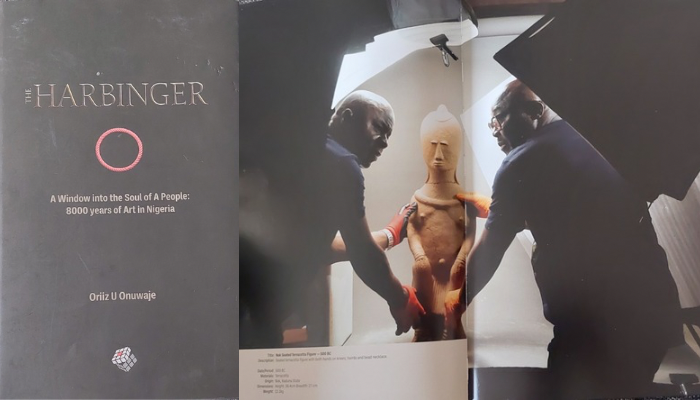
Author: Oriiz U Onuwaje
Pagination: 81 pages
Publisher: Crimson Fusion
Year: 2025
Reviewer: Obinna Emelike
If you have come across Oriiz Onuwaje, you will appreciate the depth of his creative thinking, ingenuity and commitment to his calling. All that, especially his creative ingenuity is evident in this book, The Harbinger, which is the fourth-part landmark series culminating in A Window into the Soul of A People: 8000 Years of Art in Nigeria.
Also, if you are an art enthusiast, culture lover, researcher, history lover or an African heritage conservationist, Onuwaje’s book will surpass your expectations due to the depth of research in the series, originality of the works, confirmable sources and endorsements by owners.
Dedicated to Fred Egbe, the author’s late cousin, a lawyer and an art collector, the book is timely considering that for a long time, the history of Art in Nigeria has been presented as a series of magnificent, but sadly, disconnected events such as the Dufuna Canoe; the striking terracottas of Nok; the bronze realism of Ife; the ceremonial regalia of Igbo-Ukwu and the courtly majesty of Benin.
Therefore, ‘A Window into the Soul of A People: 8000 Years of Art in Nigeria’ is the author’s intentional effort to connect these revered masterpieces, whose isolation in Western narratives have obscured their essence and value.
As further reiterated in his forward of the book, Olugbile Holloway, director general, National Commission for Museums and Monuments (NCMM), also declared that The Harbinger by Oriiz Onuwaje is a good effort at giving the story of art in Nigeria a central voice instead of the fragmented analysis, isolations, aberrations and framings.
The book features over 60 original artworks, across wood carvings, brass, metal, bronze, clay and other media of artistic expressions. It also captures The Dufuna Canoe Excavation, Ife Bronze Head of 12 AD, Nok Terracotta Figure- 500 BC, Metal Anklet -14th Century, Benin Bronze Lidded Vessel -16th Century, Carved Ivory Bowl with fitted lid – 16th Century, Benin Bronze leopard Waist pendant – 16th Century, Ife Terracotta Ooni Head -12 AD, Igbo Ukwu Bronze Vessel 9th Century, Igbo Ukwu Bronze Bowl Stand – 9th Century, Benin Elephant Ivory Tusk -16th Century, Benin Bronze Memorial Head of an Oba – 16th Century, Owo Terracotta Hand Holding a Rabbit Head – 12 AD, Brass Bowl, Epa Mask, Face Mask, among other works, whose originality and creative ingenuity of the creators are intriguing.
As the author rightly points out in the introduction, the multiple artistic languages developed over eight millennia ago is an unbroken thread of time in Nigeria and a symbol of resilience. Therefore, in this book, the author combines scholarly and curatorial authority to reveal history across the eight millennia from Nok to Ife, from Igbo-Ukwu to Benin, and to others, amid evidence of continuous intellectual exchanges among these places then and even now.
According to him, ‘A Window into the Soul of A people: 8000 Years of Art in Nigeria’ confirms the exchanges across different art worlds then and also establishes that the ingenuity of the ancestors is not confined to their era, but even flows more today, amid many gifted hands.
In the section titled ‘The Consistency of Form and Philosophical Structure 6000 BCE -15th Century’, the author also traces the material record of ancient creativity, insisting that it has been a continuous and deliberate purist of form till date.
He makes reference to how the people within the Lake Chad Basin, around 6000 BCE hollowed a massive tree into a refined watercraft, which became the Dufuna Canoe. For him, the canoe is not simply an early object, but the first evidence of conceptual thinking and structural intention in this continuum of mastery.
The Nok tradition also takes the ancient creativity further in 1500 BCE by producing terracotta figures that demonstrate calibrated proportions and a structured approach to representation across both intimate and large scales. For him, the Benin and Ife copper-alloy and terracotta portrait heads, among others, reveal more advanced command of symmetry, volume and idealized physiognomy.
Highlighting the creative ingenuity of the ancestors, the author in a body of work titled, ‘A Collection of Ife terracotta Heads – 12 AD’, notes that calibration of each work in symmetry, striation and proportion is evidence of an artistic system where form, intention and identity were rendered with disciplined precision even centuries ago.
In a section he tags, ‘The Horizon of Thought: Modern and Contemporary Practices (Post -1950)’ the author narrows his focus down to The Zaria Art Society and “Natural Synthesis”.
According to him, the starting point for formal artistic dialogue began in the late 1950s, when the Zaria Art Society established itself as the Nigerian College of Arts, Science and Technology, (now Ahmadu Bello University).
The relevance of the society stems from the passion of the pioneer students such as Uche Okeke, Demas Nwoko, Bruce Onobrakpeya, among others, who were able to merge their academic training from Euro-American models with their native artistic expression and social and political context.
Rather than the foreign models, the artists, according to the author, adopted natural synthesis to gain cultural and creative autonomy. That ability to engage in a dialogue between their local heritage and international influences without copying Western art or dismissing it, is the intrigue for the author.
Also comparing notes, the author observes that this generation artists differ from the older ones, especially the Zaria folks by their treating of traditional elements as creative resources rather than confining them. They are also using modernist techniques as artistic tools instead of restrictive methods.
He also observes that the older generation artists demonstrated their independence through a synthesis that used local ideograms to create contemporary paintings, textile and graphic design.
The author also notes that Nigeria’s art scene grew significantly after the Zaria revolution, which allowed artists to boldly convert linear dynamics inherent in the ideograms and their graphic elements into modern painting.
However, he also notes that the Osogbo School operated as a counter movement, which established workshops in Osogbo to reach artists with non-academic methods that birthed artists who made vibrant mythological artworks through batik, beadwork, printmaking and cement sculpture techniques.
The takeaway from the school, according to him, is that the group, consisting of Twins Seven Seven and Sussane Wenger, along with others, proved that local myths and materials could thrive in contemporary artistic practices.
He also points to the fact that mastery in iron and fire has existed before modern art, which emerged through canvas and galleries in Nigeria. In view of the above, David Nwume and John Uzoka, two Awka blacksmiths, entered an international iron-forging competition between 1924 and 1925 in England, and they won.
The author uses a 14th century metal anklet with carinated cylindrical body flanked by fin-like lateral ridges to illustrate the early ingenious iron works.
While the creativity intrigues and volume of artworks piles, the author insists that stewardship cannot be over emphasized, especially protection of artifacts through preservation efforts, against environmental damage, insect infestation and natural ageing processes.
Beyond physical preservation, he urges for digital support, citing an instance with the memorandum of understanding between the National Commission for Museums and Monuments (NCMM), and independent curatorial partners. The MoU will enable responsible documentation, digitalisation and exhibition of collections.
In the book, the author also says that education is needed as it builds capacity, especially heritage education, which focuses on capacity development instead of pride-based learning.
In his conclusion, he notes that Nigeria maintains an extended dialogue with form, spirit, and society, representing one of humanity’s longest creative traditions.
But the ultimate goal, according to the author, is to take the heritage of our collective cultural heritage out of the silence of glass shelves and return it to the pulse of the people. He also insists that the griot must rise again not only with drums, but with pixels and code, rhythm of reels, poetry of posts and the syncopation of the Afrobeat.
The Harbinger, whose Forward and Preface were respectively written by Olugbile Holloway, director general, National Commission for Museums and Monuments (NCMM), and Professor Frank Ugiomoh, Department of Fine Arts and Design, University of Port Harcourt, is available on Amazon, orature.africa and oriiz.com.
Join BusinessDay whatsapp Channel, to stay up to date
Open In Whatsapp