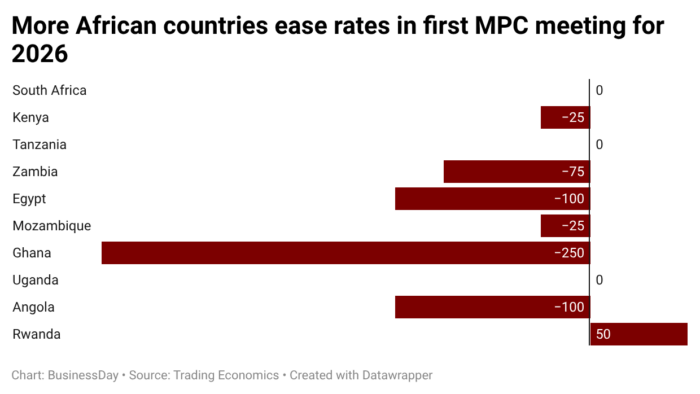
Rwanda’s central bank has delivered its biggest interest rate increase in almost three years to contain near-term inflation, bucking a broader shift toward monetary easing across Africa.

The Monetary Policy Committee on Thursday raised the key policy rate to 7.25 percent from 6.75 percent at its first meeting of 2026. The move pushes borrowing costs to their highest level since August 2023 and brings cumulative tightening to 75 basis points since the National Bank of Rwanda resumed rate hikes last year.

Authorities said the increase is aimed at keeping inflation within the 2–8 percent target range.

The decision sets the East African economy apart from much of the continent, where policymakers in Kenya, Egypt, Angola, Ghana, Mozambique, and Zambia have cut rates, while Uganda, South Africa, and Tanzania have opted to hold as inflation continue to ease and currencies stabilise—supported in part by strong precious metal prices.

“The decision is a measured step we are taking to bring inflation back within the target band, which is a necessary condition to sustain economic growth,” said Soraya Hakuziyaremye, governor of the National Bank of Rwanda, at a post-meeting briefing.

She added that the MPC would continue to monitor inflation and broader economic developments and stands ready to adjust policy if price pressures intensify beyond current projections.

Hakuziyaremye noted that risks to the inflation outlook include weaker agricultural output, persistent energy-related cost pressures, and global or regional geopolitical tensions.

Headline inflation has risen for a second consecutive month to a seven-month high of 7.5 percent in January, up from 5.2 percent in December, with urban inflation accelerating to 8.9 percent from eight percent.

Based on current central-bank forecasts, inflation is expected to remain slightly above eight percent in the first half of this year before easing back toward the target band by year-end.

Despite mounting price pressures, the country’s economic growth remains robust. The finance ministry projects annual expansion will stay above 7 percent through 2028.

However, the outlook has weakened since November, reflecting poorer-than-expected food supply in the final months of 2025, sharper-than-anticipated fuel-price increases, and firmer underlying pressures from core components such as housing, restaurants, and hotels, the governor said.

Bunmi holds a degree in Economics from the University of Lagos and has over eight years of experience in content writing and journalism. Her career spans roles as a financial and business journalist at BusinessDay Media and TechCabal, and as Head of Research at SBM Intelligence, an Africa-focused market intelligence and strategic consulting firm. She also served as Editor at Finance in Africa, a subsidiary of Businessfront and is currently Assistant Editor, Finance (Africa), at BusinessDay.

Join BusinessDay whatsapp Channel, to stay up to date

Open In Whatsapp