The pattern is familiar in boardrooms and executive meetings alike.
The numbers tighten. Forecasts wobble. Meetings multiply. Decisions slow.
According to Akin Monehin, a business transformation & strategy execution executive who works across executive education and corporate advisory, this moment is often misdiagnosed. What looks like indecision, he argues, is rarely a failure of intelligence or intent. More often, it is a failure of design.
Under financial pressure, organisations do not break because leaders do not know what to do. They falter because the systems supporting decision-making were never built to function under strain.
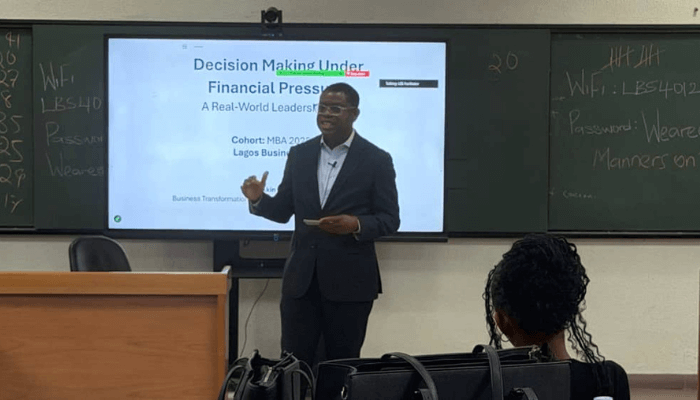
This observation emerged repeatedly during recent executive classroom discussions at Lagos Business School, where senior managers examined how leadership behaviour changes when financial pressure intensifies.
The illusion of decisiveness
In periods of stress, organisations often mistake visible action for effective leadership. Executives feel compelled to demonstrate control: announcing quick initiatives, restructuring teams, accelerating timelines, or issuing public reassurance.
Yet these actions frequently prioritise optics over infrastructure. Public signals are amplified while the underlying systems required to support execution remain fragile or misaligned. Decisions appear bold, but are unsupported by the mechanisms needed to sustain them.
The result is a cycle many organisations recognise. Activity increases, confidence messaging intensifies, but performance remains unstable.
Where pressure distorts judgment
Discussions during the Lagos Business School session highlighted recurring decision patterns that surface when financial constraints bite.
One is the preference for speed over responsibility. Leaders accelerate decisions to project momentum, often at the cost of consultation, psychological safety, and risk visibility. Communication becomes compressed. Dissent retreats. Errors surface later, when reversal is costly.
Another is the tension between short-term relief and long-term viability. Measures taken to stabilise cash flow or protect margins may undermine workforce trust, operational resilience, or strategic capacity. Compassion and sustainability are framed as competing objectives, rather than design challenges to be reconciled.
A third distortion emerges when early success masks fragility. Organisations confuse momentum with stability, choosing to preserve narrative continuity rather than confront structural weakness.
As Monehin noted during the session, financial pressure does not create these tensions. It exposes them.
A framework for understanding execution under stress
To analyse these behaviours, facilitators introduced a practical lens commonly referred to as the C3 Formula™, which frames execution under pressure as the interaction of Clarity, Cadence, and Consequence.
Clarity refers to seeing the truth behind the numbers, not just the numbers themselves. Under pressure, organisations often delay acknowledging uncomfortable realities, narrowing the window for corrective action.
Cadence describes the rhythm that keeps decisions coherent. Without deliberate pacing, organisations oscillate between panic and paralysis, undermining both speed and quality.
Consequence emphasises that every decision carries costs beyond immediate financial impact. Choices affect trust, morale, reputation, and future optionality. When consequences are ignored or deferred, execution discipline erodes.
Rather than prescribing solutions, the framework helps leaders diagnose where execution is likely to fail when stress rises.
Why organisations misread decisiveness
One of the most revealing insights from the session was how often organisations reward the appearance of decisiveness rather than the architecture that supports it. Leaders who move fast are celebrated, even when the systems beneath them cannot absorb the velocity.
This misalignment creates brittle organisations. They perform adequately in stable conditions, but fracture under volatility. When pressure arrives, decision quality degrades, not because leaders lack competence, but because governance, incentives, and information flows were never designed for stress.
Designing before pressure hits
The lesson for executives is not to slow down, but to prepare differently.
Organisations that navigate pressure effectively invest early in decision clarity, protect decision cadence, and make consequences explicit before crisis forces trade-offs. They treat execution as a system, not a personality trait.
As economic uncertainty persists globally, this distinction is becoming decisive. As Monehin observes, leaders who design for pressure do not eliminate stress. They ensure that when it arrives, it reveals strength rather than fragility.

Join BusinessDay whatsapp Channel, to stay up to date
Open In Whatsapp