


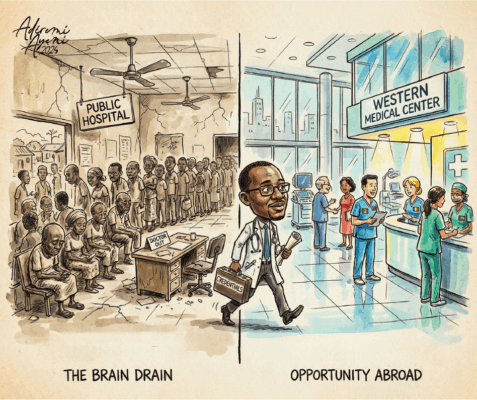
Nigeria’s healthcare system carries a painful contradiction. Public hospitals across the country struggle with staff shortages, overstretched facilities, and declining service quality, yet Nigeria remains one of the world’s most reliable exporters of medical talent. Today, over 12,000 Nigerian-trained doctors practise in the United Kingdom alone, making Nigeria one of the largest sources of foreign-trained doctors in the UK. This figure excludes those working in Canada, the United States, the Middle East, and elsewhere. At the same time, Nigeria remains one of the most doctor-deficient countries globally. With an estimated doctor-to-population ratio of about 2.9 doctors per 10,000 people, far below the World Health Organisation’s recommended minimum, many public hospitals operate well below safe staffing levels. This is not merely ironic, it is diagnostic of deeper institutional failures.
Public debate on medical brain drain in Nigeria are often towards moral judgement, framing migration as a lack of patriotism or national commitment. This framing is misplaced. The migration of highly skilled professionals, particularly doctors, is rarely emotional. It is a rational response to incentives, working conditions, and career prospects. Talent moves to where it can function effectively, grow professionally, and earn a dignified living. Nigeria’s healthcare system increasingly fails on all three fronts.
Doctors trained in Nigeria undergo a rigorous and competitive process that meets global standards. Much of this training is subsidised by public funds, including clinical exposure in teaching hospitals. In theory, this investment should translate into a stronger national health system. In practice, the benefits are largely realised elsewhere. Destination countries absorb these doctors with minimal retraining because the skills are already there. Nigeria, however, bears the full cost of training while losing the service, productivity, and institutional memory that should have followed. Economically, this amounts to a steady transfer of value from a weaker system to stronger ones.
Why, then, do doctors leave? The answers are well known but insufficiently confronted. Working conditions in many public hospitals remain punishing. Facilities lack basic diagnostic equipment, functional laboratories, reliable electricity, and essential consumables. Doctors are frequently forced to improvise or practise below acceptable standards, watching preventable complications and deaths occur not from lack of knowledge, but from lack of tools. Over time, this erodes professional confidence and ethical satisfaction. For many doctors, migration is not simply about earning more, but also about being able to save lives consistently.
Compensation further compounds the problem. Doctors’ wages have not kept pace with inflation, rising living costs, or the demands of the profession. In a context where healthcare is central to national development, remuneration remains misaligned with responsibility, risk, and workload. Poor pay is not just a welfare issue; it signals how society values medical labour. Countries that retain doctors do so by recognising healthcare as productive infrastructure, not a discretionary social expense.
Equally important is career stagnation. Opportunities for specialist training, research funding, and advancement remain limited, unpredictable, or influenced by bureaucracy and patronage. Residency slots are constrained, fellowship pathways poorly funded, and research self-financed. For professionals, this creates a ceiling rather than a ladder. In contrast, systems abroad offer timelines, funded training, and promotion structures. Migration thus becomes a means of professional survival rather than aspiration.
The consequences of this exodus are systemic. Doctor shortages lengthen waiting times, increase fatigue, and raise the risk of error. Public hospitals struggle, pushing households towards costly private care or delayed treatment. Preventable illness turns into disability, reducing productivity and increasing long-term costs for families and the state. Healthcare is therefore an economic pillar, not merely a social service. Yet policy responses miss the mark. Bonding schemes, exit restrictions, and patriotic appeals treat symptoms, not causes. Retention cannot be forced. It depends on functional institutions, predictable career paths, adequate pay, and professional respect that make doctors choose to stay home.
A serious retention strategy must therefore begin with institutional reform. Public hospitals must be properly equipped and maintained. The fact that many private hospitals outperform public ones is not because they are wealthier, but because they are better structured, monitored, and managed. Government investment must prioritise modern equipment, maintenance culture, and procurement transparency, alongside accountability for performance.
Pay structures must be reformed to reflect economic realities and professional demands, treating healthcare spending as long-term investment rather than recurrent cost. Training and career development should be institutionalised through consistent funding for residency programmes, sponsored fellowships and continuous professional development, signalling commitment to medical excellence. Equipping doctors with functional tools and systems that help them save lives would itself become a powerful retention mechanism. Professional respect is equally critical. Doctors stay where rules are clear, promotions are merit-based and institutions function predictably. The discipline Nigerian doctors observe abroad is structural, not cultural, and can exist at home as well.
The diaspora also represents potential, not just loss. Many Nigerian doctors abroad remain willing to contribute through training, partnerships, and investment. However, diaspora engagement cannot substitute for domestic capacity. Without functional hospitals and institutions, such contributions offer only temporary relief.
Ultimately, the presence of thousands of Nigerian doctors abroad is not the core problem. The real issue is why Nigeria struggles to keep them. Brain drain reflects institutional weakness. Until the conditions driving migration are addressed, the cycle will persist. The choice is not patriotism versus migration, but whether Nigeria builds systems to stay in or continues exporting human capital it cannot afford to lose.

Join BusinessDay whatsapp Channel, to stay up to date
Open In Whatsapp


