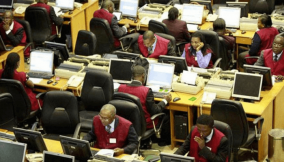
After a historic 2025 that ushered the Nigerian Exchange (NGX) into N100 trillion market capitalisation league, 2026 has opened with a clear message: the bull run isn’t over, but it is becoming more selective.
With the March 2026 banking recapitalisation deadline looming and the highly anticipated listing of the Dangote Refinery and Dangote Fertiliser on the horizon, “smart money” is no longer just buying the index—it is rotating into specific pockets of value.
As inflation begins to moderate and the foreign exchange (FX) market finds its footing, market analysts are zeroing in on three high-stakes sectors.
Whether you are looking for dividend stability or aggressive capital appreciation, these are the industries primed to lead the next phase of the 2026 rally.
At the Arthur Steven annual market outlook, the firm recommended 70 percent equities, 20 percent fixed income, and 10 percent cash for the first half (H1) of the year.
With consumer demand stabilising and pressure on the naira easing, companies with strong local production are emerging as clear winners. MTN Nigeria, Nestlé, Unilever, Presco, Okomu Oil, GTCO, are some of the companies experts are choosing to bet on this year.
“We are positive on equities for the first half of the year, and this is reflected in our model portfolio,” said Tunde Amolegbe, managing director, Arthur Steven Asset Management, in a webinar series titled ‘2025 Marcoeconomic review & outlook for 2026’.
Consumer Goods: Betting Nigerians will spend again …
MTN Nigeria, Nestlé, and Unilever are Arthur Steven’s plays on consumer recovery. For two years, inflation crushed purchasing power. Now, with disinflation well underway, real incomes are stabilising.
MTN posted service revenue of over N1 trillion in Q1 2025, a 40.5 percent year-on-year increase, while profit after tax more than doubled with 134 percent growth to N133.7 billion. The company’s debt metrics remain healthy, with a net debt-to-EBITDA ratio of just 0.1 times as of September 2025, well within covenant thresholds. As interest rates decline, MTN’s debt servicing burden eases further, freeing up cash while consumers with more disposable income spend more on data and value-added services.
Nestlé swung from a N184.3 billion loss in the first nine months of 2024 to a N72.5 billion profit in the same period of 2025, driven by a 33 percent revenue increase to N884.5 billion and, crucially, a massive reduction in net finance costs linked to exchange rate stability. Unilever matched that momentum, doubling nine-month profit to N22 billion on 50 percent revenue growth to N155.4 billion, with operating profit surging 200.7 percent as margins expanded.
Both companies import significant raw materials and have been battered by naira weakness. With the exchange rate stabilising in the N1,358–N1,500 range, their cost bases measured in naira terms are moderating. If the naira holds and consumers keep spending, these stocks offer both margin expansion and volume growth.
The firm is “holding our position” on these names, Amolegbe said, signalling confidence that input cost relief and volume recovery will align in 2026.
Agriculture: Protected and profitable…
Four names, Okomu Oil, Presco, Dangote Sugar, and Flour Mills, dominate Arthur Steven’s agriculture weighting. This is not a trade; it’s a structural call.
Government policy discourages agricultural imports through FX restrictions and tariffs, handing local producers pricing power. Okomu and Presco, both palm oil producers, have posted stellar earnings. Presco’s half-year profit soared to N88.7 billion in 2025, already surpassing the N77.7 billion it made in all of 2024, while revenue climbed to N198.7 billion. Okomu gained 150 percent on the NGX in 2025 as crude palm oil prices rallied and local production displaced imports.
Dangote Sugar and Flour Mills hedge food inflation while benefiting from backward integration. As long as the CBN and trade ministry favour local production, these companies operate in a protected market with inflation-linked pricing.
Banks: Rate cuts and stronger balance sheets…
GTCO anchors the financial services bet. After recapitalisation strengthened balance sheets across the sector, Tier-1 banks enter 2026 positioned to gain from falling rates and rising transaction volumes.
Nigeria’s banking sector posted mixed results in 2025, with the NGX Banking Index up 39.77 percent, lagging the broader market’s 51.19 percent gain. But that underperformance masks selective strength: investors rewarded banks with solid fundamentals and clear strategies. For GTCO and peers, lower funding costs as rates decline should boost margins, while a more stable FX market lifts transaction activity.
“We expect that interest rates will gradually start to trend downwards, as inflation continues to trend downwards,” Amolegbe said. “We expect that bond yields and rates on Treasury bills will also most likely start to trend downwards.”
For banks, that means margin relief. For fixed income investors, the firm recommended “long-dated bonds with high coupon and relatively high yield, because those are the ones that are likely to deliver significant capital gain as interest rate starts to trend downwards towards the end of the year.”
Treasury bill yields on 364-day paper reached a stop rate of 17.5 percent at the December 3 auction, up from 16.04 percent at previous auctions, but well below the 21.76 percent peak seen in mid-2024.
For retail investors, the takeaway is that equities with favourable trends are back in favour. For professionals, the move away from inflation hedges towards earnings tells a bigger story about how Nigerian stocks may be priced in 2026 if FX and policy remain stable.

Join BusinessDay whatsapp Channel, to stay up to date
Open In Whatsapp