


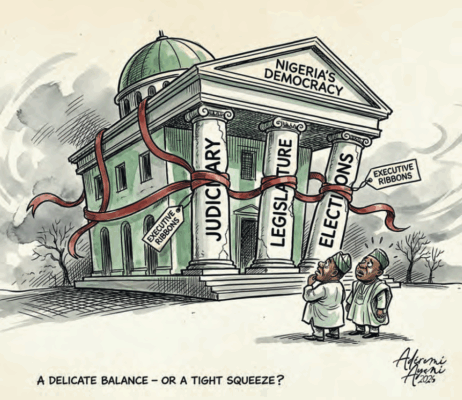
Twenty-seven years after the return to civil rule, Nigeria’s democracy – often described as one of Africa’s strongest – is confronting a new and unsettling challenge. In recent years, growing executive assertiveness, shrinking civic space, and contested electoral credibility have raised serious questions about the capacity of Nigeria’s institutions to restrain power and withstand sustained political pressure. The 1999 transition ended overt military rule, but it did not complete the deeper work of democratic consolidation.
Today, Nigeria operates within a global context shaped by the V-Dem Democracy Report 2025, which identifies a “Third Wave of Autocratisation”, a process through which democracies erode not through coups, but through the gradual weakening of checks and balances.
However, Nigeria’s experience cannot be understood solely through global frameworks. What is emerging locally is best described as “Executive Convenience Democracy”, a system in which democratic institutions formally exist and operate, but their independence is conditional. Courts function, legislatures sit, and elections hold, yet their authority is controlled. Institutions are permitted to act freely until their actions conflict with executive priorities, at which point security, public order, or national interest narratives intervene. Democracy is preserved in form but restricted in substance.
Across the world, democratic decline has become increasingly subtle. Elections continue, courts convene, and parliaments meet, yet executive power concentrates and non-electoral institutions weaken. Hungary, Turkey, and India illustrate this pattern, where legal and bureaucratic frameworks are repurposed to entrench executive dominance. In Nigeria, similar signals are visible. Between 2025 and 2026, public order and national security justifications were repeatedly deployed to constrain civic space and regulate digital expression. A notable example occurred in February 2025, when the Lagos State Judiciary suspended a planned mass protest against insecurity, citing “public safety concerns”. While lawful on the surface, the decision exposed a deeper vulnerability: the judiciary’s limited capacity to resist executive narratives during moments of pressure. Such moments are stress tests of Nigeria’s institutional resilience.
Modern democratic backsliding relies less on force than on compliance. Legislatures defer. Courts hesitate. Security agencies interpret ambiguity in favour of authority. Data from Nigeria’s 2024 – 2025 legislative cycles reveal repeated attempts to introduce bills restricting free speech and protest, often receiving minimal scrutiny. Oversight is increasingly shaped by political alignment rather than constitutional duty. In contrast, Senegal’s 2024 constitutional crisis demonstrated institutional courage when its Constitutional Council blocked an attempt to delay elections. Brazil and Poland similarly show that democratic recovery is possible when courts and legislatures function as autonomous arbiters rather than extensions of executive power. A resilient democracy is not one where institutions follow the executive, but one where they retain the capacity to say no.
Democratic erosion is not merely a political concern; it carries significant economic costs. The ICNL 2025 Study on Civic Space and Development shows that countries restricting freedom of association struggle to attract long-term investment. In Nigeria, constrained civic space accelerates capital flight, intensifies the “Japa” brain drain phenomenon, and weakens policy feedback mechanisms. Civic space is therefore not a moral luxury; it is economic infrastructure. When dissent is suppressed, governance errors compound unnoticed, producing systemic shocks.
If Nigeria is to reverse this trajectory, reform must follow a clear and realistic sequence. The first priority is institutional immunity. The judiciary, INEC, and the National Assembly Service Commission must receive constitutionally protected, first-line funding insulated from executive discretion. Security vote allocations at both federal and state levels should be subject to legislative disclosure, and judicial decisions restricting civic action must carry mandatory, publicly accessible reasoning.
The second phase is constraint rebalancing. Legislative committees must regain enforceable subpoena powers, while heads of security agencies should face independent confirmation panels that include civil society representation. State assemblies require constitutional autonomy from governors to restore meaningful subnational oversight. Nigeria’s problem is not strong executives; it is executives without sufficient counterweights.
The third phase involves renewing civic infrastructure. Whistle-blowers must receive statutory protection, anonymity guarantees, and financial incentives. A National Civic Data Access Law should grant citizens access to government records, while a Nigerian Digital Rights Charter must protect online expression from political intimidation. Without strong feedback loops between citizens and the state, democratic decay becomes self-reinforcing.
Security sector reform is equally critical. Nigeria must shift from regime security to constitutional security. Clear legal thresholds should govern protest restrictions, with criminal liability for unlawful enforcement of executive directives. Any protest ban should be subject to parliamentary review within seventy-two hours. This is not about weakening the state, but about restoring legitimacy to its coercive power.
Nigeria’s democracy is not yet failing, but the risks are measurable and immediate. If institutional independence continues to erode, investor confidence will weaken, civic trust will collapse further, and talent flight will accelerate. Moments such as the February 2026 protest suspension are not anomalies; they are signals. They reveal how executive convenience can override civic agency when institutions lack insulation.
Nigeria’s future will not be secured by strong leaders alone. It will be determined by the resilience of institutions and their capacity to withstand pressure without bending. By insulating core institutions, protecting civic space, and treating democratic norms as national assets rather than political obstacles, Nigeria can shift from fragility to measurable resilience. The republic will thrive not on personalities, but on systems capable of holding power to account.

Join BusinessDay whatsapp Channel, to stay up to date
Open In Whatsapp


