Capital as a Window into Economic Belief
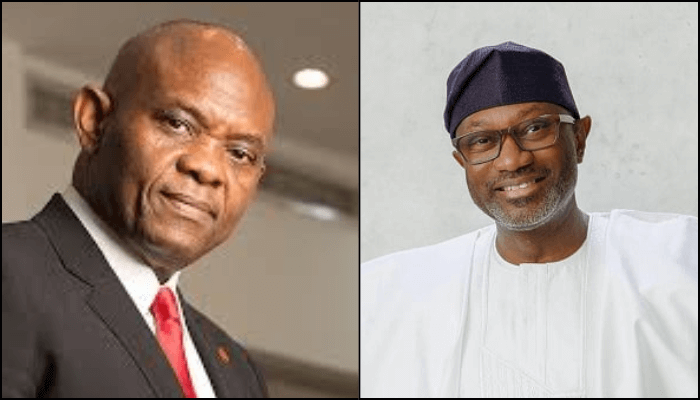
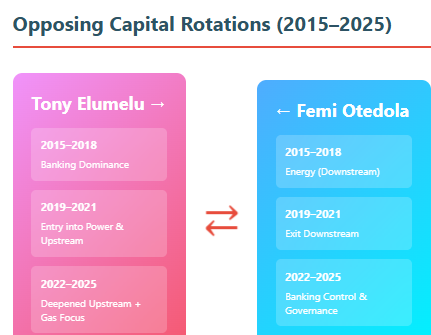
Nigeria’s top business figures are often described as opportunistic, but that label misses something important. Their capital decisions are less about quick wins and more about how they read risk over time. Where they place money, where they withdraw it, and how long they are willing to wait all tell us something about how they understand the country’s economic direction. Few examples make this clearer than the contrasting paths taken by Tony Elumelu and Femi Otedola. Over the last decade, Elumelu has steadily shifted from banking into energy, while Otedola has moved in the opposite direction, stepping away from energy exposure to deepen control in banking. These moves are not personal quirks or tactical trades. They reflect two different ways of interpreting Nigeria’s economy, its risks, and where durable value is most likely to sit. Read together, they form a useful guide to how serious capital navigates uncertainty in Nigeria.
Read also: Nigeria’s security risks overhyped, economy rebounding, says Tuggar
Elumelu’s Bet on Scarcity
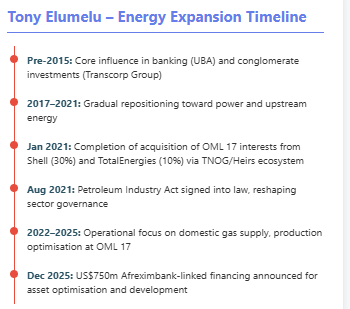
Elumelu’s move into energy is best understood through a simple idea: Nigeria is not short of demand, it is short of supply. Growth stalls not because people are unwilling to spend, but because power, gas, and crude evacuation constrain how far businesses can scale. In such economies, value tends to sit upstream, close to the bottleneck. This helps explain the acquisition of OML 17, a mature onshore oil asset international companies were keen to exit. The risks were obvious—security challenges, ageing infrastructure, regulatory complexity, and community relations—but so was the opportunity. Upstream assets have high fixed costs, which makes them look unattractive when disruptions are frequent. But when stability improves even slightly, the payoff can be large. Small gains in uptime or evacuation reliability can translate into strong cash flows. Elumelu’s emphasis on financing credibility, domestic gas supply, and operational discipline shows a preference for execution over optimism.
Waiting for Normalisation, Not Comfort
What stands out about Elumelu’s strategy is its patience. This is not a bet on quick fixes or near-term calm. It is a belief that, sooner or later, Nigeria must use more energy to grow. Whether through gas-to-power, domestic refining, or industrial expansion, higher utilisation is inevitable. Owning productive assets ahead of that moment is uncomfortable and capital-intensive, but potentially rewarding. The approach accepts short-term pain in exchange for long-term positioning. It also recognises a hard truth about Nigeria’s real economy: the biggest gap is often not between resources and demand, but between ownership and execution. Assets do not fail here because they lack potential; they fail because operations break down. Elumelu’s focus on production optimisation and disciplined financing reflects an understanding that managerial capacity, not geology, ultimately determines outcomes.
Read also: Why Nigeria’s demographic advantage keeps failing the economy
Otedola’s Turn Toward Financial Control
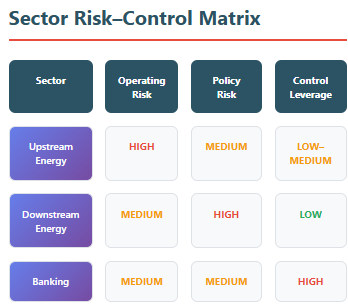
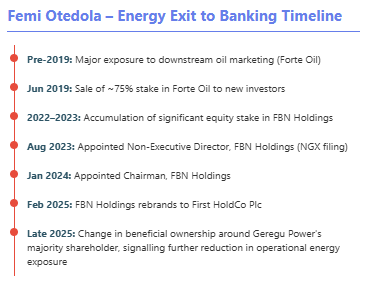
Otedola read the same environment and reached a different conclusion. His exit from downstream oil marketing in 2019 was not a rejection of energy itself, but of a business model increasingly shaped by policy rather than performance. Regulated margins, subsidy uncertainty, foreign exchange exposure, and working-capital strain turned downstream fuel marketing into a sector where profitability depended more on fiscal politics than operational skill. The exit was not defensive; it was strategic. From there, Otedola rotated into banking, gradually building influence in one of Nigeria’s most systemically important institutions and eventually assuming the chairmanship. Banking, unlike energy, is not about physical output. It is about control—over governance, capital allocation, and balance sheets—especially during periods of economic reset.
Power in a Repricing Economy
Otedola’s banking focus reflects a view that Nigeria is in a prolonged repricing phase. Since 2023, prices across the economy have been reset—fuel subsidies removed, exchange rates adjusted, interest rates raised. In such moments, the balance of power shifts. Asset values move, leverage matters, and access to credit determines which firms survive and which fail. Control of a financial institution allows an investor to influence outcomes rather than simply absorb shocks. Who gets funded, at what price, and under what conditions becomes more important than owning physical assets exposed to operational volatility. Even Otedola’s later reduction of indirect exposure to a listed power asset fits this pattern. The preference is clear: less exposure to operational risk, more influence over the financial plumbing of the economy.
Read also: Nigeria economy to grow above 5% in 2026 — Adebajo
Two Readings, One Nigeria
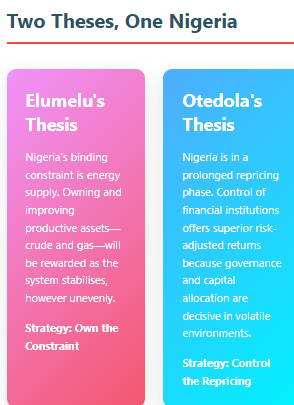
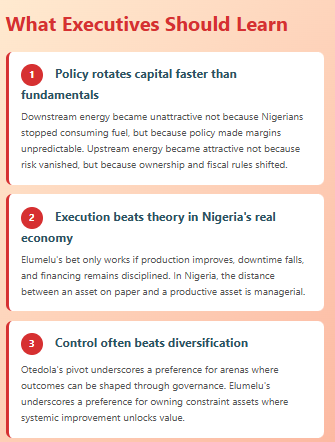
Placed side by side, these strategies tell us something important about Nigeria. Elumelu’s approach assumes that energy scarcity remains the binding constraint and that owning productive assets will pay off as governance and infrastructure slowly improve. Otedola’s approach assumes that repricing and balance-sheet repair will define the cycle, making control of financial institutions more attractive. Both views are internally consistent. Both accept volatility as normal. The difference lies in where each believes power sits at this point in the cycle. Sometimes it sits in molecules—gas and crude—when scarcity dominates. At other times, it sits in institutions—banks—when repricing reshapes the economy. The deeper lesson is not about who is right. It is about understanding risk well enough to choose the kind you are best equipped to manage.

Join BusinessDay whatsapp Channel, to stay up to date
Open In Whatsapp