The judiciary in Nigeria is no longer the hope of the everyday person
Efficient contract enforcement is critical to the economic growth and sustainability of any nation, because without the enforceability of laws, protection of the rights of the enforsee, and the respect of the rule of law – all of which are hinged on the effectiveness of the judicial system of that nation— then enforcement of laws becomes a daunting task. Economies start failing long before numbers show distress, when obligations lose weight, promises become optional, and contracts, social tools that enforce trust and enable long-term planning, weaken, allowing opportunism, rewarding delay, and eroding moral consequence, so that fragile systems collapse not from lack of money but from the breakdown of credible enforcement, as seen in Nigeria and similar climes. For enforcement to work, the country must have a well-functioning judicial system, where cases are resolved in a timely manner and justice is indeed the hope for the common man. That is not the case in Nigeria today, as there are cases that drag on for over a decade, two or even more in some cases, thus making it difficult for the common man to get justice and encouraging higher defaults in contract obligations.
Read also: Rewane sees Nigeria heading for its biggest economic boom in a decade

Erosion of fear and the rise of consequence failure
When contracts carry real consequences, borrowers act cautiously and trust builds over time, but when defaults become negotiable and enforcement is weak, borrowing turns aggressive, repayment is bargained, and default becomes routine, teaching the market that it is safer to owe than to repay, turning integrity into a disadvantage and risk-taking into an asymmetric strategy.
Moral hazard, defensive lending, and the suffocation of productive firms
Given the growing rate of defaults, moral hazard widens across the market, pulling even disciplined firms into questioning whether responsibility still has any reward as chronic loan defaulters continue to thrive, and banks and money lenders react by raising interest rates, shortening tenors, and tightening approvals, to protect themselves, in an environment where enforcement keeps losing bite, leaving small and productive businesses without the political cover or legal strength to survive whilst capital drifts toward players who exploit loopholes, delay or evade repayments, ignore character, resist discipline, and manipulate weak institutions, creating not just a simple credit shortage, but a deeper consequence crisis where value creators suffocate and enforcement-proof actors rise instead.

How weak enforcement corrodes trust and economic culture
Weak enforcement erodes trust as systems that should run on quiet, predictable discipline systems, instead drown in noise, with scandals provoking public outrage, politicians meddling, and selective crackdowns, creating drama without restoring order, teaching people that consequences are inconsistent and nudging them to treat every contract as negotiable, turning delay into strategy and strategy into culture, until even institutions that try to uphold rules are painted as harsh, while calls for sympathy replace respect for discipline, blurring the line between compassion and impunity, a pattern visible in Nigeria today, where chronic restructuring, endless rollovers, and avoidance of hard-loss recognition normalise defaults as misfortunes rather than gross misconduct and allows time to be weaponised against lenders in ways that weaken the entire economic culture.
Read also: NESG identifies productivity, structural reforms as vital catalysts for economic expansion
“The enforceability of contracts is a fundamental determinant of economic performance, acting as the psychological and institutional infrastructure upon which advanced markets are built.”

The hidden economic cost of leniency and the shift from production to bargaining
Every unpaid financial obligation generates hidden economic costs as suppliers wait indefinitely, workers face wage delays, and prices rise to cover risk, forcing honest borrowers to pay more whilst inequality grows, and when contracts lose their power, firms shift focus from productivity, discipline, and innovation toward leverage, bargaining, and delaying enforcement, making negotiation a competitive advantage, diverting energy from building to positioning, gradually eroding growth and misallocating talent, whilst the economy consumes itself from within, a subtle yet profound consequence of sustained leniency and inconsistent discipline.
Rebuilding consequence, engendering accountability, restoring trust, and the role of specialist enforcement partners
The logic that leads to consequence failure can be reversed, but only through calm, consistent enforcement, rather than rhetoric or occasional interventions, as predictable application of rules adjusts borrower behaviour, restores lender confidence, extends capital time horizons, and gradually unclogs court systems, easing economic anxiety not through liquidity but through reliability, which is why strong economies invest in independent enforcement institutions, whilst in Nigeria the problem lies in framing enforcement as punitive rather than foundational, allowing influence to distort processes, treating obligations as flexible instead of sacred and sacrosanct, and demonstrating that no amount of subsidies, bailouts, or funding can restore growth if trust in contracts is not rebuilt, because economies decay slowly when consequences soften and contracts lose their authority, turning future growth into mere memory rather than trajectory. Specialist enforcement firms like Kreeno Consortium restore trust where contracts and formal enforcement fail, using debt recovery, asset tracing, private investigation, and governance support to reinforce consequences quietly and professionally, return stalled capital to productive use, and shift the market from bargaining-driven behaviour back toward disciplined investment, production, and sustainable growth.
Comparative analysis: Contract enforcement as the bedrock of economic stability
The enforceability of contracts is a fundamental determinant of economic performance, acting as the psychological and institutional infrastructure upon which advanced markets are built. This analysis compares nations with strong contract enforcement regimes versus those with weak contract enforcement regimes, demonstrating how this single factor catalyses cascading economic effects.
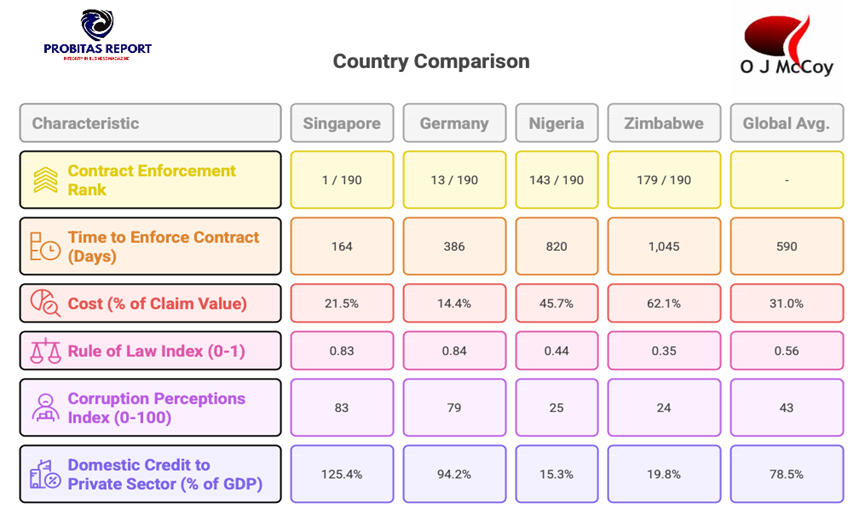
Table 1: Quantitative Metrics of Contract Enforcement (2023 Data) Sources: World Bank Doing Business (Final Report 2020), World Justice Project (WJP) Rule of Law Index 2023, Transparency International (TI) CPI 2023, IMF Financial Development Index.
Case contrasts in application
Germany’s “Pacta sunt servanda”: This legal principle (“agreements must be kept”) is deeply embedded. Its specialised commercial courts and the Bundesgerichtshof (Federal Court of Justice) ensure rulings are predictable and respected, facilitating Germany’s Mittelstand SME engine.
Nigeria’s Judicial Congestion: As of 2023, over 70,000 commercial cases were backlogged in Nigerian High Courts. Enforcement of a simple debt can take over 3 years, rendering many contracts de facto unenforceable. This directly correlates with Nigeria’s stagnant private credit-to-GDP ratio (sub-20% for decades).
Read also: We’re committed to contributing meaningfully to Nigeria economic — Indigenous Agribusiness
Singapore’s International Commercial Court (SICC): Established to handle cross-border disputes, the SICC offers global businesses a trusted, efficient enforcement venue. This strategically positions Singapore as a commercial hub, attracting capital far disproportionate to its size.
Table 2: Economic Outcomes Linked to Enforcement Regimes
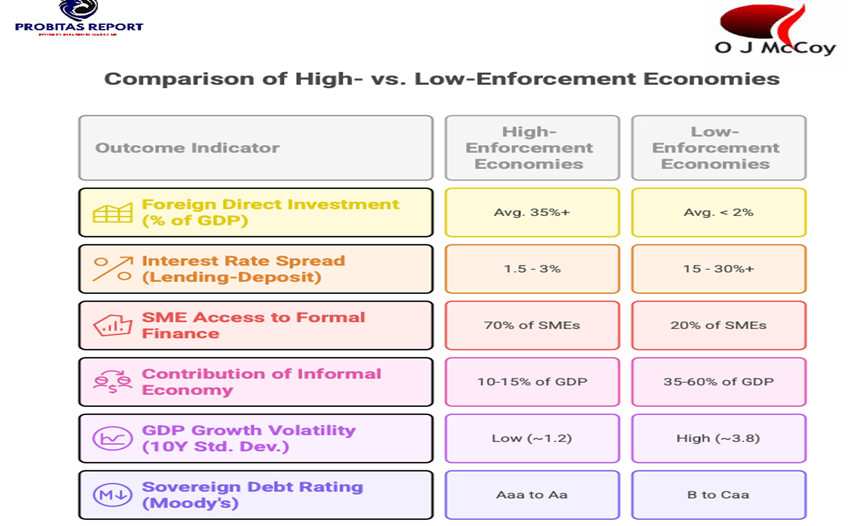
Conclusion: The psychological infrastructure of capital
Economies depend on trust as much as capital, with strong contract enforcement driving growth through credit and investment, while weak enforcement breeds distrust, stagnation, and underdevelopment, a gap Kreeno Consortium seeks to close in Nigeria through private-public partnerships combating financial fraud.
For more information or enforcement support, contact Prof. Prisca Ndu on [email protected] and WhatsApp: +234 902 148 8737.

Join BusinessDay whatsapp Channel, to stay up to date
Open In Whatsapp