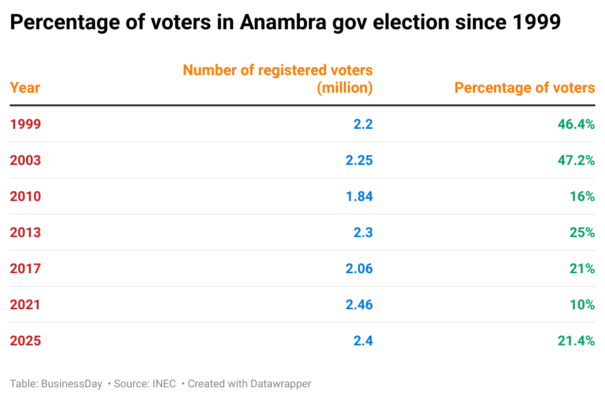
Voter participation in Anambra State gubernatorial elections continues to lag significantly despite slight improvement in the November 8 election.
The election was won by the All Progressives Grand Alliance (APGA) candidate and incumbent governor Chukwuma Soludo. Soludo won in all 21 local government areas (LGAs), making him only the second individual to achieve this in Anambra’s history, after former Governor Willie Obiano in 2017.
But despite his overwhelming victory across the South-eastern state, the gubernatorial election was a sad reminder of the apathy that has characterised elections in Nigeria and indeed Anambra State in the last two decades.
Data from Nigeria’s election umpire, the Independent National Electoral Commission (INEC) and civic society observers, shows that the turnout in the November 8 election stood at about 21.4% of the registered electorates.
According to INEC, 16 candidates from 16 political parties participated in the election.
The state has a total of 2,788,864 registered voters, out of which 598,229 were accredited for the election, representing 21.4 percent participation.
A total of 595,298 votes were cast, while 11,244 votes were rejected across the 21 local government areas of the state.
The figure represents a mark increase from the historic low of about 10.3% that was recorded in 2021, 253,388 accredited from 2,466,638 registered voters.
With the current trend, experts say that the level of engagement remains below democratic expectations. Perhaps, what is also more worrying is that Anambra State has never achieved a turnout of 50 percent in any of its gubernatorial elections since the return to democracy rule in 1999.
Read also: Why Soludo swept Anambra governorship poll
“Some local governments in the district, such as Anambra East, Anambra West, and Ogbaru, are largely riverine and made up of hard-to-reach communities, with a higher voter-to-polling-unit ratio than other districts,” Bukola Idowu, executive director, Kimpact Development Initiative, an election monitoring group said.
“These factors have contributed significantly to voter fatigue, disenfranchisement, and the persistent low turnout in the region”.
Anambra’s history of voter apathy
Upon the return to democratic rule in 1999, Anambra State has consistently recorded low voter participation in gubernatorial elections.
Although experts have attributed several reasons for the trend, data from the Centre for Journalism Innovation and Development (CJID) observers, shows that Anambra state’s governorship elections have been below fifty percent in voter turnout.
In 1999, only 1.02 million of the 2.2 million registered voters cast their ballots, representing 46.4 per cent. The 2003 election saw the highest turnout with 47.22 per cent.
By 2010, turnout had dropped to 16 per cent, with just 302,000 voters participating out of 1.84 million registered. Participation slightly improved in 2013, when 465,891 of 1.77 million voters turned out, representing about 25 percent. Four years later, in 2017, only 448,711 of 2,064,134 voters (21 per cent) showed up at polling units.
The decline reached its lowest point in 2021 when only about 10 percent of registered voters participated. While the 2025 figure of 21.4 per cent marks an improvement, it remains far below democratic expectations.
Election turnout across Nigeria
Voter turnout in the November 8 gubernatorial election in Anambra may be low, but the situation shows a growing trend of voter apathy across Nigeria.
In the last two decades, Nigerians’ aversion to voting during elections is well documented with the situation increasingly becoming a concern to political stakeholders and the electoral umpire.
According to Yiaga Africa, national voter turnout has continuously declined from 69 per cent in 2003 to just 27 per cent in the 2023 general election, the lowest since 1999.
In 2023, only about 25 million valid votes were recorded out of 93 million registered voters. Yiaga Africa attributes the decline to several factors, including an inflated voter register, poor mobilisation, insecurity, and waning trust in the electoral process.
In the 2023 gubernatorial election the average turnout across 28 states was 31 per cent, but South-east states recorded the lowest. Ebonyi recorded the region’s highest turnout at 22 percent, while Abia and Enugu managed only 18 percent.
Northern states, compared to other regions, did better, with four states recording turnout above 40 per cent. Across Nigeria’s recent elections, including off-season polls, turnout has consistently remained below 35 per cent.
According to INEC data, some by-elections have recorded as low as three to eight per cent participation. In Edo’s 2024 governorship election, only 25.9 per cent of registered voters who had collected their PVCs participated. In 2020, Ondo election recorded a 32.8 per cent turnout.
The 2023 figure was a decline of 8.03 percent, from the general election in 2019 in which turnout was 34.74 percent.
Data from the election management body shows that Nigeria’s voter turnout has been declining almost every year since 2007.
Read also: How Anambra poll defined Amupitan’s job
Security concerns, credibility of election
Experts say the legitimacy of emerging governments in a democratic political system hinge on the extent to which eligible voters come out to vote for them during elections.
The persistent trend of voters’ apathy seen in the Anambra gubernatorial elections remains an issue of concern to advocates of democracy and its sustenance in the country.
But observers say security concerns remain a major factor in the low turnout in the November 8 Anambra gubernatorial election.
They attribute the low participation to IPOB-led sit-at-home orders and general insecurity across the state.
Kunde Okunade, political scientist said many parts of the state still remain unsafe and volatile, noting that it may have contributed to low turnout.
According to him, insecurity is still an issue in Anambra State, the capital may be safe but in many remote villages and communities, there are still cases of kidnapping and other crimes.
“People are scared to come out in villages, some came out, the security is not tight there like we have in big cities”, he added.
Similarly, Sylvester Odion Akhaine, professor of political science at Lagos State University (LASU) said the militarisation of the governorship election and the fear of violence may have affected turnout of voters.
“People were scared because of insecurity and the militarisation of the election and you can’t blame them”, the political scientist said.
Similarly, Tunde Odeyemi, an election observer and civil society activist, who monitored the Anambra gubernatorial election, told BusinessDay that many citizens stayed away from the poll because of past experience, fearing that their votes would not count.
He pointed out that citizens have lost trust in the electoral umpire to conduct a credible poll and questioned whether elections lead to tangible improvements in governance.

Join BusinessDay whatsapp Channel, to stay up to date
Open In Whatsapp