A fourfold capital hike promises sector transformation. The evidence suggests something messier.
When Nigeria’s insurance regulator announced fourfold increases in minimum capital requirements in July 2025, the market response told two contradictory stories simultaneously. Regency Assurance surged 150%, Sovereign Trust climbed 124%, and Mutual Benefits defied gravity with a 248% rally.
Consolidated Hallmark Holdings PLC gained 38 per cent in Q3. Investors, it seems, are pricing both triumph and disaster—a rational response to reform that is either existential rescue or regulatory overreach, depending on which balance sheet you examine.
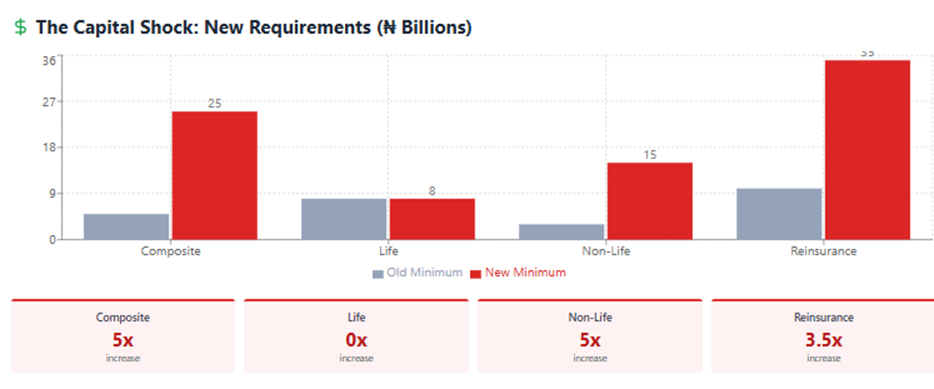
The directive is certainly ambitious. Composite insurers must now raise ₦25 billion (up from ₦5 billion), while reinsurers face a ₦35 billion threshold. For an industry whose total market capitalisation barely exceeds ₦700 billion and whose collective assets reached ₦1.64 trillion in H1 2025, this is not an incremental adjustment. It is shock therapy administered to a sector that regulators have diagnosed as chronically undercapitalised—but whose real ailments may be more complex than capital deficiency alone.
Read also: FG urges insurance directors to champion sector transformation, compliance
The diagnosis: More than capital
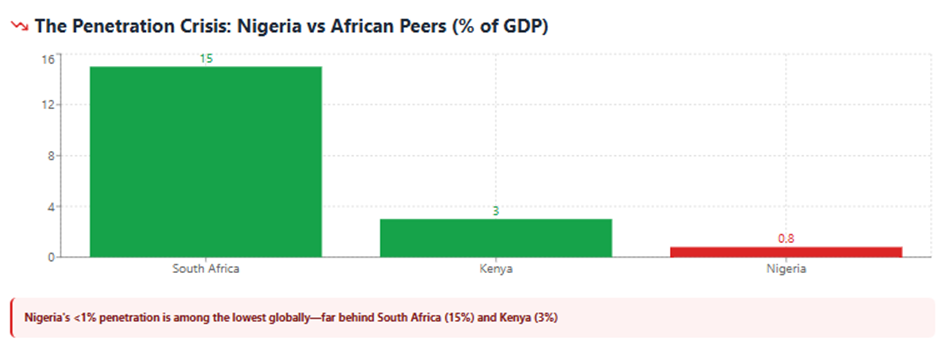
Nigeria’s insurance penetration rate hovers stubbornly below 1% of GDP—among the lowest globally and far behind African peers like South Africa (15%) or Kenya (3%). The National Insurance Commission’s (NAICOM) theory is straightforward: undercapitalised insurers cannot underwrite large risks, cannot inspire policyholder confidence, and cannot invest in the digital infrastructure or actuarial talent required for modern operations. Stronger balance sheets, the logic goes, enable domestic risk retention, prompt claims settlement, and market expansion into underserved segments. But H1 2025 data reveal a sector struggling with problems that capital alone cannot cure. The combined ratio, claims plus expenses as a share of premiums, averaged 74% across listed firms, yet ranged wildly from 24% (Veritas Kapital) to 133% (Mutual Benefits). Several insurers recorded expense ratios above 60%, indicating cost structures inconsistent with competitive underwriting. This is not a sector whose primary problem is insufficient capital. It is a sector with insufficient competitiveness.
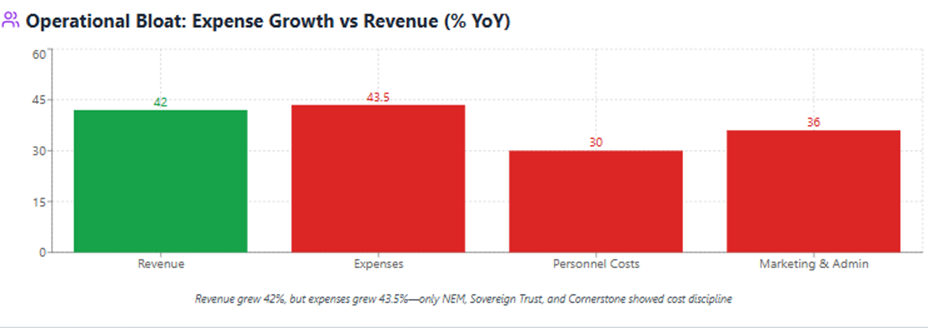
Three pathologies stand out. First, chronic mispricing. Nigerian insurers have competed on premium volume rather than underwriting profitability, accepting risks at rates insufficient to cover long-term claims liabilities. When inflation surged past 30% in 2024, reserves proved catastrophically inadequate. Claims ratios spiked; premium adjustments lagged. Second, investment fragility. Nigerian insurers hold ₦986 billion in investment assets, overwhelmingly concentrated in government securities. Investment income grew 58.6% to ₦63.6 billion in H1 2025, buoyed by elevated Central Bank rates. Yet net investment income, after fair value adjustments and foreign exchange losses, plunged 30.6%. Returns are rate-dependent, not diversification-driven. When monetary policy eventually eases, this income stream collapses. Third, operational bloat. Personnel costs rose 30% year-on-year, while marketing and administration expenses jumped 36%—both outpacing revenue growth (42%). Only NEM, Sovereign Trust, and Cornerstone demonstrated cost discipline.
“The likely outcome is consolidation—potentially healthy if it eliminates zombie firms and creates scale efficiencies. But Nigerian M&A has a poor track record.”
The consolidation lottery
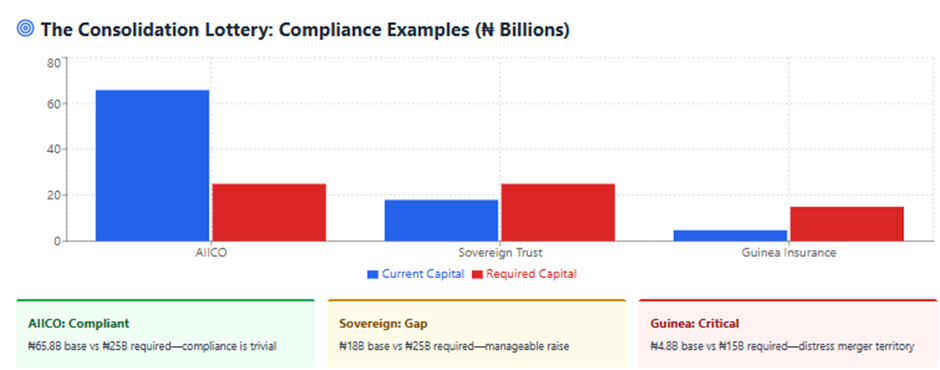
For well-capitalised firms like AIICO (current base ₦65.8 billion, requirement ₦25 billion), compliance is trivial. For marginal players like Guinea Insurance (₦4.8 billion base, ₦15 billion required), the shortfall exceeds market capitalisation. These firms face dilutive equity raises at depressed valuations, distress mergers on unfavourable terms, or licence forfeiture. The likely outcome is consolidation—potentially healthy if it eliminates zombie firms and creates scale efficiencies. But Nigerian M&A has a poor track record. Banking sector consolidation in 2005, similarly motivated, produced larger but not necessarily better institutions. Weak banks merged with weak banks, creating weak conglomerates that required repeated government bailouts. Without concurrent regulatory strengthening, stress testing, corporate governance standards, actuarial oversight, recapitalisation could simply create “too big to fail” insurers without addressing operational deficiencies. Moreover, timing is inopportune. Nigerian equities remain depressed, foreign investor appetite is tepid, and macroeconomic volatility makes long-term capital commitments unattractive. Expect significant ownership churn: private equity firms and foreign insurers will acquire distressed assets cheaply. This may improve management quality—or simply transfer economic rents from Nigerian shareholders to foreign capital.
Read also: PenCom, NAICOM direct insurance firms to stop business with defaulting employers
What would actually work
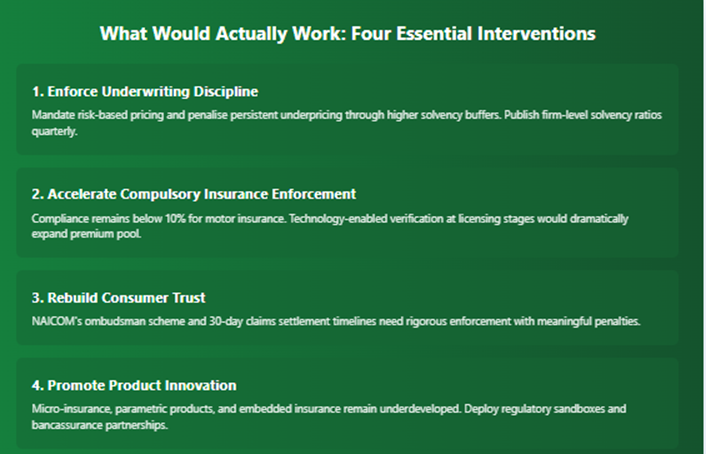
Recapitalisation is necessary but insufficient. Four complementary interventions are essential:
Enforce underwriting discipline. NAICOM must mandate risk-based pricing and penalise persistent underpricing through higher solvency buffers. If insurers cannot price risk accurately, more capital simply funds larger losses. Kenya’s Insurance Regulatory Authority publishes firm-level solvency ratios quarterly, creating peer pressure for prudent reserving. Nigeria should follow suit.
Accelerate compulsory insurance enforcement. Nigeria mandates insurance for buildings, motor third-party liability, and professional activities—yet compliance remains below 10 percent for motor insurance. Technology-enabled verification at vehicle licensing or building permit stages would dramatically expand the premium pool and reduce adverse selection, where currently only high-risk individuals voluntarily insure.
Rebuild consumer trust. The industry suffers a trust deficit: too many Nigerians have experienced claims delays, technicality-based denials, or outright non-payment. NAICOM’s proposed ombudsman scheme and 30-day claims settlement timelines are steps forward but require rigorous enforcement with meaningful penalties. Insurance will not achieve mass-market penetration until claims settlement becomes predictable and fair.
Read also: NAICOM sets working group to drive compulsory insurance, digitisation, inclusions for growth
Promote product innovation. Micro-insurance, parametric products (rainfall-indexed crop insurance), and embedded insurance (coverage bundled with e-commerce or ride-hailing) remain underdeveloped despite the obvious market need. Regulatory sandboxes could enable experimentation, while bancassurance partnerships, underutilised despite bank branch ubiquity, could bypass expensive broker networks.
The real test ahead
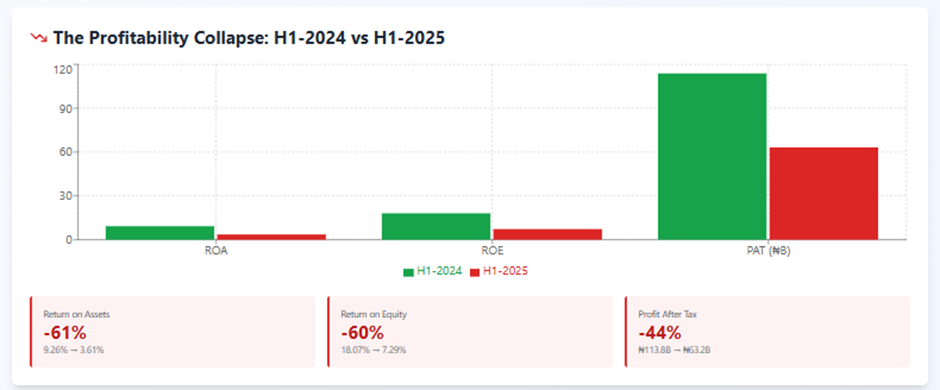
Total industry assets grew 25.19% to ₦1.64 trillion in H1 2025, and investment income surged on elevated interest rates. Yet profitability collapsed. Profit after tax declined 44.46% year-on-year to ₦63.2 billion as expenses surged 43.45%. Return on assets fell from 9.26% to 3.61%; return on equity dropped from 18.07% to 7.29%. Revenue grew, but value contracted. This is the inconvenient truth recapitalisation alone cannot address: Nigerian insurers are operationally inefficient, actuarially undisciplined, and investment-dependent rather than underwriting-driven. Stronger balance sheets may enable larger risk retention and improved public confidence. But without simultaneous improvements in underwriting discipline, investment sophistication, operational efficiency, and regulatory enforcement, recapitalisation merely creates better-capitalised mediocrity.
The test will come not in June 2026, when compliance is verified, but in 2027-2028, when macroeconomic conditions normalise and the sector must demonstrate profitable growth, reliable claims settlement, and voluntary, not compulsory, insurance uptake. If penetration remains stuck below 1 percent, if claims disputes continue plaguing policyholders, and if insurers remain unable to retain catastrophic risks domestically, then recapitalisation will have been an expensive theatre rather than transformative reform. For now, investors are betting both ways—and the wild variance in individual firm performance reveals deep uncertainty about who survives and who thrives. In Nigeria’s insurance sector, as in Nigerian markets generally, the distinction between reform and disruption is thinner than regulators prefer to admit. Whether this recapitalisation proves creative or merely destructive depends less on the capital raised than on what firms, and regulators, do with it. The sector stands at an inflection point. Capital provides the means for transformation. Whether it delivers the will remains to be seen.
Dr Oluyemi Adeosun, Chief Economist, BusinessDay Media

Join BusinessDay whatsapp Channel, to stay up to date
Open In Whatsapp